
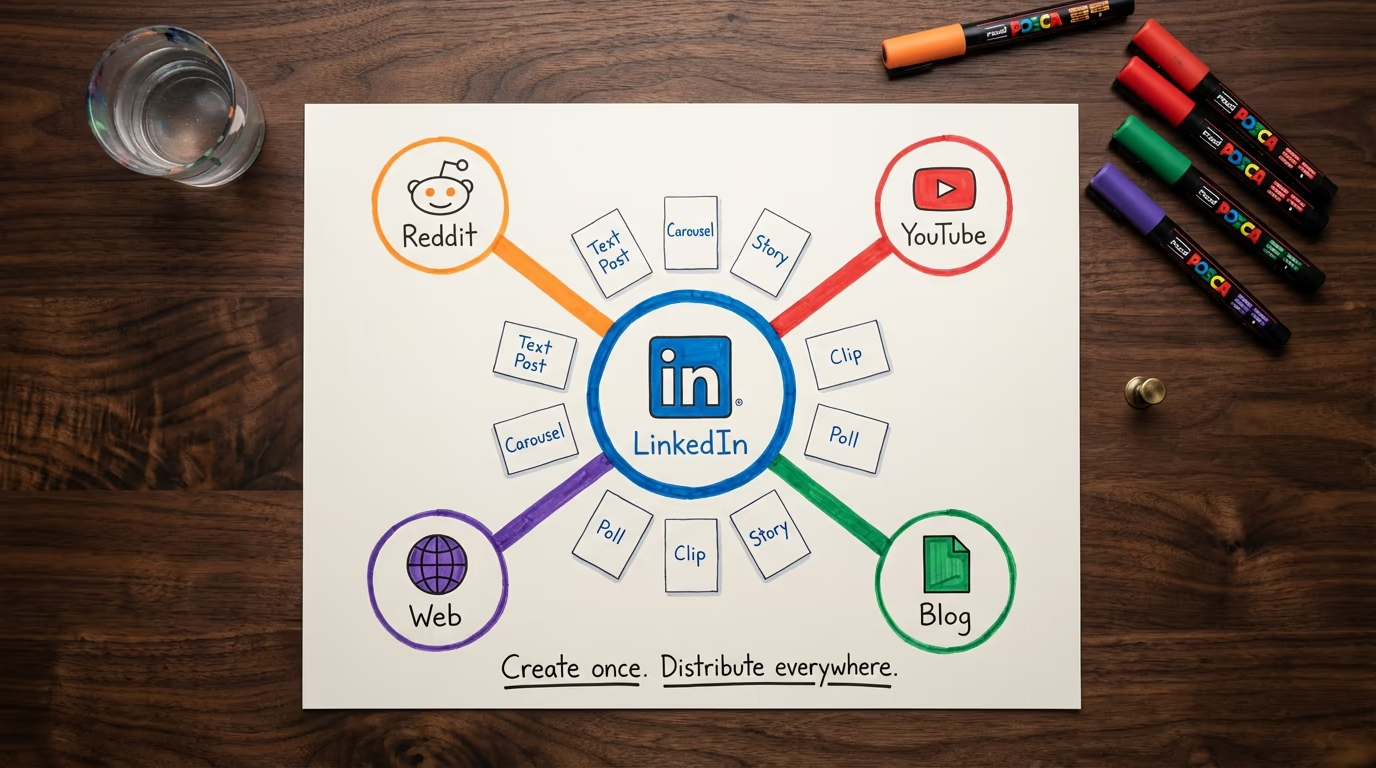
Blog post to LinkedIn batch: 15 to 20 minutes for 5 to 7 posts. This is the fastest per-post path because text-to-text repurposing requires the least format translation. You are highlighting the best moments in a written article and rewriting them as standalone LinkedIn posts. The same idea works in reverse, since a LinkedIn article you write is itself a dense source you can break into a week of posts. The structural similarity between blog paragraphs and LinkedIn posts means the adaptation is mostly about adding a hook and tightening the format rather than fundamentally reimagining the content. The biggest lie in LinkedIn content advice is that you need to create something new every time you post. This advice burns people out within weeks, leads to mediocre posts published just to fill a schedule, and ignores the fact that the most consistent creators on the platform have a secret: they are not producing fresh ideas from scratch every day. They are running a content repurposing strategy for LinkedIn to save time and grow faster by turning content they have already created - or content they consume - into a steady pipeline of LinkedIn posts that feel original because they are formatted, angled, and hooked differently each time. LinkedGrow's content repurposing toolkit supports every source type covered in this guide, but the framework itself is what makes the whole system work regardless of which tools you use.
The concept is simple: create once, distribute everywhere. A single YouTube video holds enough material for ten LinkedIn posts. One blog article yields five to seven. A viral Reddit thread can become three engaging posts before the topic even trends on LinkedIn. And a web article you read over your morning coffee can turn into a thought leadership piece that positions you as the person in your industry who always knows what is happening. When you combine all four source types into a weekly rhythm, you end up with more content than you can publish, which means you get to pick only the best ideas instead of scraping the bottom of your brain for something - anything - to post before lunch.
This guide is the pillar piece for LinkedGrow's complete repurposing strategy. It covers the four source types, how to adapt content specifically for the LinkedIn algorithm, the weekly workflow that keeps your pipeline full, and the time estimates so you know exactly how much effort this takes in practice.
Which 4 content sources feed your LinkedIn pipeline?
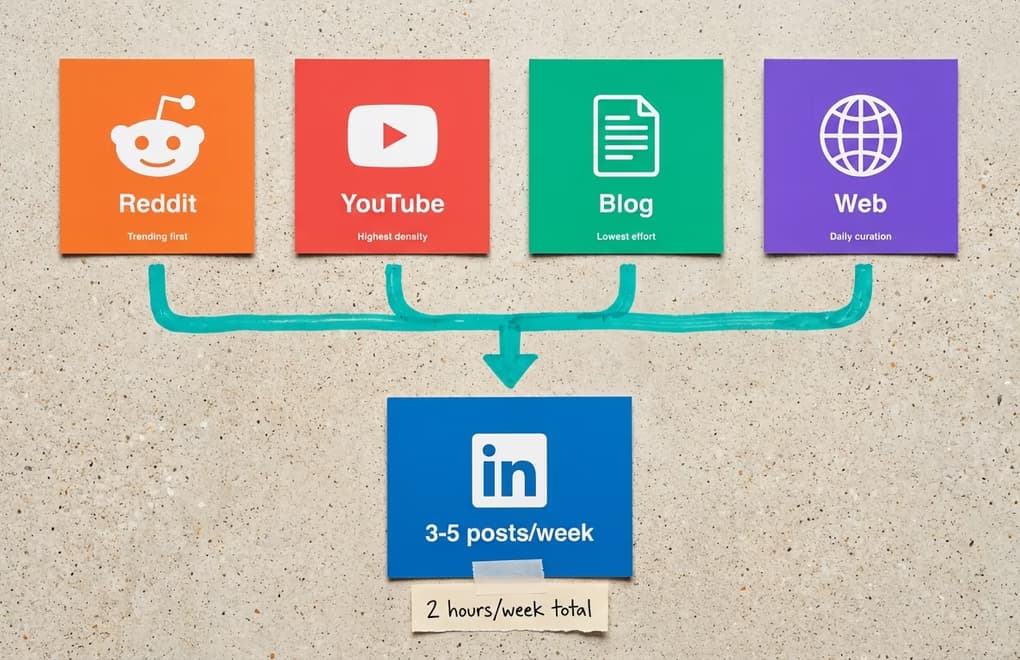
Every piece of content you encounter falls into one of four source categories, and each one requires a slightly different extraction approach to produce great LinkedIn posts. Understanding these categories is the first step to building a repurposing habit that actually sticks, because it means you start seeing LinkedIn content opportunities everywhere instead of sitting down to a blank screen wondering what to write about.
Reddit threads are your early-warning system for trending topics. Discussions on Reddit surface 24 to 48 hours before they hit LinkedIn, which gives you a window to be the first person in your network to share an informed take on a developing story. LinkedGrow's Reddit-to-LinkedIn feature lets you paste any Reddit URL and extracts the key insights, generates hook options, and creates full post variations tailored to your voice. The value here is timeliness - Reddit repurposing works best when you act within hours of spotting a relevant thread, not days later when every LinkedIn creator has already covered the same topic.
YouTube videos are your highest-density source material. A single 15-minute video contains enough insights for 8 to 12 LinkedIn posts across text, carousel, clip, and story formats. The conversion requires a format translation - you are turning audio and visual content into written and swipeable content - which means the output feels more original to your LinkedIn audience than the source material would suggest. Most of your LinkedIn connections have never seen the YouTube video, so every extracted insight is new to them.
Blog posts are the lowest-effort repurposing path because your source material is already written text. You are not translating between formats - you are atomizing one long piece into multiple shorter pieces, each rewritten with a LinkedIn-optimized hook and formatted for the feed. A typical 1,500-word article produces five to seven LinkedIn posts, and the extraction process takes about 15 minutes with LinkedGrow's blog-to-LinkedIn feature or about 30 minutes manually.
Web articles - news stories, research reports, product launches, industry analyses - are your curation fuel. Every day you read content that your LinkedIn audience would find valuable but has not seen because it lives on websites they do not visit. Sharing your perspective on a web article positions you as someone who stays on top of developments in your field, and LinkedGrow's web-to-LinkedIn feature extracts the content from any URL and generates posts that add your voice and insight rather than just sharing a link.
How do you adapt any content for LinkedIn's algorithm?
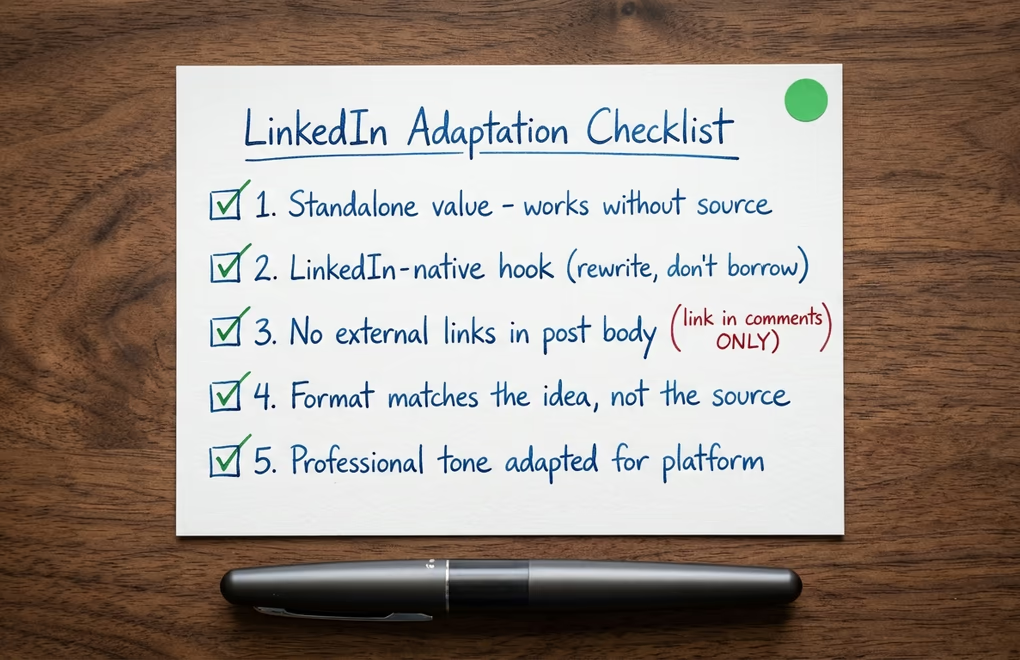
The difference between repurposing that works and repurposing that flops comes down to one principle: every LinkedIn post must work as a standalone piece of content that delivers complete value without the reader needing to consume the original source. If your post feels like a summary, a trailer, or an ad for something that lives somewhere else, people scroll past and the algorithm takes note. The posts that perform are the ones where someone who has never heard of you and has no context can read the entire thing and walk away having learned something worth their time.
The hook carries most of the weight. Regardless of where your content originated, the first two lines of your LinkedIn post need to stop someone mid-scroll before the "see more" button cuts your post off. The hook that worked for your YouTube thumbnail or your blog headline almost never works as a LinkedIn hook because the context is completely different. On YouTube, people are browsing for something to watch. On LinkedIn, they are skimming between meetings. Your hook needs to create enough curiosity, relevance, or surprise in 140 characters to earn the click, and that usually means rewriting the opening from scratch rather than borrowing it from the source.
Keep everything native to LinkedIn. This is the adaptation rule that makes the biggest difference to your reach and it applies across every source type. Never paste a YouTube URL, Reddit link, or blog URL into your post body because LinkedIn penalizes posts with external links by reducing their distribution significantly. If you want to reference the source, mention it in the post text and drop the link in the first comment. Better yet, use the zero-click approach - deliver all the value in the post itself and let readers who want more find the source through your profile's Featured section.
Match the format to the content type, not to the source format. Two free tools handle the final polish for repurposed posts: the LinkedIn text formatter for bolding pulled quotes, and the LinkedIn character counter to trim long-form excerpts to fit before the "see more" cut. A step-by-step process from a YouTube video should become a carousel, not a text post trying to describe visual steps in paragraphs. A powerful quote from a blog article should become a standalone text post with that quote as the hook, not a link to the article with "great read!" as the caption. A trending Reddit debate should become a poll or a contrarian take post, not a copy of the Reddit thread. The format you choose for LinkedIn should be whatever format gives that specific idea the most impact in a feed context, regardless of what format it was in originally.
What weekly repurposing workflow fills your calendar?
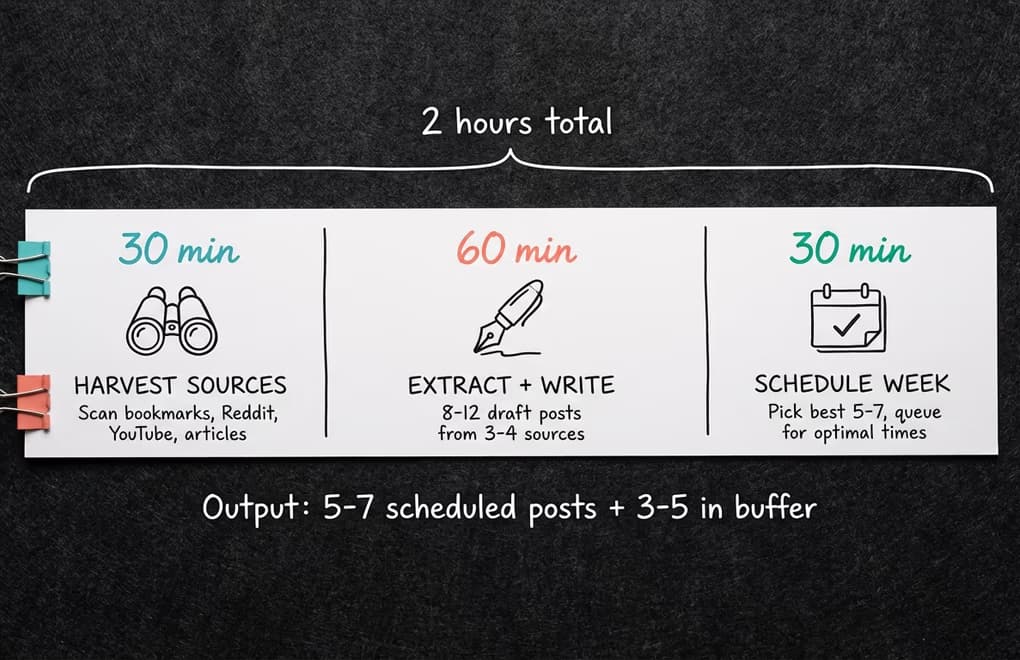
A content repurposing strategy only works if it fits into your actual life, which means it needs to be structured as a repeatable weekly session rather than a vague intention to "repurpose more." The workflow below takes about two hours per week and produces enough content to maintain a three to five post per week cadence on LinkedIn without ever needing to write something from scratch. Most solopreneurs do this on Sunday evening or Monday morning, but the specific day does not matter as long as it is consistent. If you want to scale this further, consider combining repurposing with a LinkedIn newsletter, which lets you reach your audience directly without algorithm friction while creating feed posts from your best newsletter content.
First 30 minutes: harvest your sources. Scan your browser bookmarks, saved Reddit posts, YouTube watch history, and recently published blog articles for content that would resonate with your LinkedIn audience. You are not writing anything yet - you are building a shortlist of three to four pieces of source content that contain ideas worth sharing. Most people already have this material lying around because they consume content daily; the only difference is that now you are collecting it intentionally rather than letting it disappear into your browsing history.
Next 60 minutes: extract and write. Take your three to four source pieces and run each through the repurposing process. For each one, identify two to three standalone insights and write them as LinkedIn posts with hooks, or convert a framework into a carousel outline. Use LinkedGrow's AI post generator to get from raw insight to polished draft faster - paste the source URL and the AI handles extraction, hook generation, and post writing, leaving you to edit and refine rather than write from blank. By the end of this hour, you should have eight to twelve draft posts across different formats.
Final 30 minutes: schedule the week. Review your drafts, pick the best five to seven for the coming week, and schedule them using LinkedGrow's scheduling feature at optimal posting times. Save the remaining drafts for the following week. You now have a full week of LinkedIn content queued, with leftover material that gives you a head start on next week's session. Over time, this surplus builds into a content buffer that means you never face the stress of needing to publish something right now with nothing prepared.
How long does repurposing take by source type?
One of the reasons people hesitate to start repurposing is that it sounds like "more work" on top of their existing content creation. In practice, it replaces most of the work. Here is how long each source type actually takes to process, based on what we see from LinkedGrow users who have made repurposing their primary content workflow.
Reddit thread to LinkedIn post: 5 to 10 minutes. Paste the URL, the AI extracts the discussion, you pick a hook, choose a post variation, make a few edits, and schedule. This is the fastest repurposing path because Reddit threads are already structured as conversations with clear opinions and takeaways. The time goes up if you want to create multiple posts from one thread, but a single high-quality post from a trending Reddit discussion takes less time than writing a tweet.
YouTube video to LinkedIn batch: 20 to 30 minutes for 8 to 12 posts. The transcript extraction takes seconds, the insight identification takes a few minutes of scanning, and then writing the individual posts takes the bulk of the time. With the AI generating first drafts, you are editing rather than writing, which cuts the time per post roughly in half. If you are also creating carousel outlines or cutting native video clips, add another 15 minutes for the visual formats.
Blog post to LinkedIn batch: 15 to 20 minutes for 5 to 7 posts. This is the fastest per-post path because text-to-text repurposing requires the least format translation. You are highlighting the best moments in a written article and rewriting them as standalone LinkedIn posts. The structural similarity between blog paragraphs and LinkedIn posts means the adaptation is mostly about adding a hook and tightening the format rather than fundamentally reimagining the content.
Web article to LinkedIn post: 5 to 10 minutes. Similar to Reddit in speed and simplicity. Paste the URL, the AI extracts the article content, you add your perspective and voice, edit the output, and schedule. The main creative work is deciding what angle to take on the article that adds your unique viewpoint rather than just restating what the article already says. Curation posts where you share your take on someone else's research or analysis are among the most effective formats on LinkedIn for building authority.
Which repurposing mistakes kill your LinkedIn engagement?
The most common repurposing failure is copying instead of adapting. Taking a paragraph from your blog post and pasting it into a LinkedIn composer with a link at the bottom is not repurposing - it is lazy sharing, and it performs terribly because the format, the hook, and the length are all wrong for the LinkedIn feed. Every repurposed post needs a LinkedIn-native hook, LinkedIn-appropriate formatting with short paragraphs and breathing room, and a standalone value proposition that works even if the reader never clicks through to anything else.
Publishing too many repurposed posts from the same source in the same week is the second mistake. Even though each post covers a different insight in a different format, your most engaged followers will notice the pattern if every post that week ties back to the same video or article. Mix your repurposed content with at least one or two original LinkedIn-first posts per week - a personal observation, a question for your audience, a quick hot take on something in your industry. This variety makes your feed feel like a curated stream of diverse thinking rather than a content distribution channel.
Forgetting to adapt the tone for LinkedIn's professional context catches people who repurpose from Reddit especially. A Reddit comment that uses casual slang, profanity, or extreme opinions may resonate in that community but will feel jarring in a LinkedIn feed. The insight might be gold, but the packaging needs to match the platform. Similarly, YouTube video transcripts are full of filler words, verbal tics, and repetition that work in spoken format but look sloppy in written text. Every repurposed post needs a polish pass that ensures it reads like something you would be proud to have on your professional profile.
Create Once, Distribute Everywhere
The creators who grow fastest on LinkedIn are not the ones who spend the most time creating content. They are the ones who extract the most value from everything they create and everything they consume. A single YouTube video becomes a week of LinkedIn posts. A blog article powers three weeks of content. A Reddit thread spotted on Tuesday morning becomes a trending LinkedIn post by Tuesday afternoon. When you stack all four source types into a weekly workflow, you build a content engine that runs on two hours of weekly effort and produces more consistent, higher-quality output than daily writing from scratch ever could.
Start this week. Pick one source - your most recent blog post, a YouTube video you watched last week, or a Reddit thread that caught your attention today - and turn it into three LinkedIn posts. Use LinkedGrow's repurposing tools to handle the extraction and drafting, or do it manually by reading for standalone moments and rewriting each one with a scroll-stopping hook. Schedule the posts across the next week and see what happens. You will publish better content with less effort, and you will never stare at a blank LinkedIn composer wondering what to say again.
Frequently Asked Questions
No. LinkedIn's algorithm does not detect or care whether content originated on another platform. What matters is how well the LinkedIn post itself is formatted, whether it drives engagement, and whether it keeps people on the platform. A repurposed post performs identically to an original one as long as you reformat it for LinkedIn rather than copying and pasting.
A structured repurposing workflow takes about 30 minutes per source piece and produces 8 to 12 LinkedIn posts across different formats. Without repurposing, creating that same volume of original content would take 4 to 6 hours. Most creators save 70 to 80 percent of their content creation time once the system is running.
Blog posts produce the highest volume because text-to-text conversion is the fastest path. YouTube videos produce the most varied formats because video contains visual, verbal, and narrative elements. Reddit threads produce the most timely content because trending discussions happen there first. The best strategy uses all four sources.
Change the format and angle with each repurposed post. A blog article becomes a text insight post, then a carousel, then a story post, each using a different section of the original and a different hook. Space them across two to three weeks and mix with original LinkedIn-first content so your feed feels varied rather than repetitive.
Yes. A single YouTube video or blog post typically contains five to eight distinct ideas, each of which can become its own LinkedIn post in a different format. You can return to the same source months later and create entirely new posts by choosing different insights or taking a different angle on the same topic.
The post you keep meaning to write takes four minutes here.
LinkedGrow turns a link, a video or a rough idea into a LinkedIn post written in your own voice, then puts it in the calendar for the morning your audience is awake.
Start free for 7 days