
Knowing how to write LinkedIn hooks that stop the scroll is the single biggest lever for post performance. You spend 45 minutes writing a post, proofread it twice, add the right hashtags, and hit publish at the "optimal" time. Two hours later: 12 impressions and zero comments. Meanwhile, someone posted a three-line opinion that somehow has 400 likes. The difference almost always comes down to the hook.
LinkedIn hooks are the first lines of your post that appear before the "see more" button. They are the single most important factor in determining whether your content gets read or gets buried. And yet, most people treat them as an afterthought, jumping straight into their main point without giving anyone a reason to care. With LinkedGrow, we have analyzed thousands of high-performing LinkedIn posts and the pattern is clear: posts that go viral on LinkedIn almost always start with a hook that creates an irresistible urge to keep reading.
This guide breaks down the exact science behind LinkedIn hooks that go viral. You will learn 15 proven hook formulas you can use immediately, understand the psychology that makes people stop scrolling, and get real examples from posts that generated thousands of engagements. Whether you are a solo founder trying to build your personal brand, a coach looking to attract clients, or a content creator growing your audience, mastering hooks will transform your LinkedIn results practically overnight.
By the end of this article, you will never look at the first line of a LinkedIn post the same way again.
What is a LinkedIn hook and why does it matter in 2026?
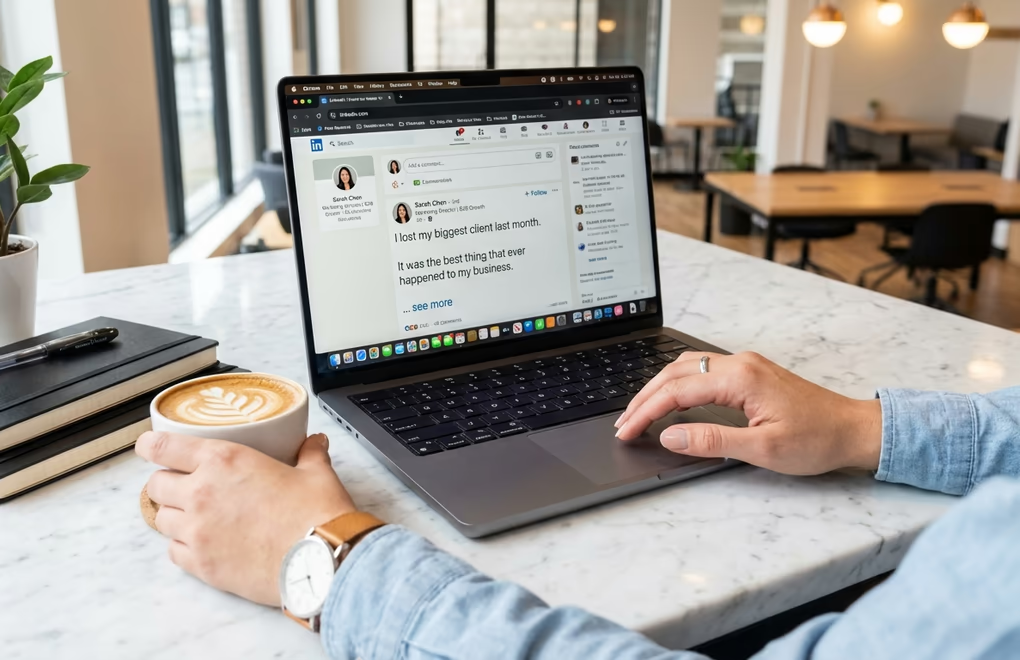
A LinkedIn hook is the opening line or lines of your post that appear above the "see more" fold. On desktop, LinkedIn shows roughly 210 characters before cutting off. On mobile, it is even less. This tiny window of text is what stands between your carefully crafted post and total obscurity in someone's feed.
Think of it like a newspaper headline. Nobody picks up a newspaper to read page six first. They scan the front page, and whatever grabs their attention determines what they read next. LinkedIn works exactly the same way, except your competition is not just other articles. You are competing against job updates, vacation photos, company announcements, and that one person who posts inspirational quotes every single morning.
The reason hooks matter so much comes down to how the LinkedIn algorithm works. When someone clicks "see more" on your post, it signals to the algorithm that your content is interesting. That click is called "dwell time," and LinkedIn tracks it carefully. More dwell time means the algorithm shows your post to more people. Fewer clicks means your post dies quietly in the feed with barely a whisper. So your hook is not just about getting one person to read - it is the trigger that determines whether your post reaches 100 people or 100,000.
Here is the uncomfortable truth: you could write the most insightful, valuable post in the history of LinkedIn, and it would not matter if nobody clicks "see more," because your hook is the gatekeeper and everything else depends on it.
The good news is that writing great hooks is a learnable skill, one that has far less to do with being clever or having a way with words than it does with understanding what makes human brains pay attention and then using that knowledge systematically.
What's the psychology behind scroll-stopping LinkedIn hooks?

Before we get into specific formulas, you need to understand why certain hooks work at a fundamental level. There are three psychological triggers that make people stop scrolling, and every great LinkedIn hook uses at least one of them.
The Curiosity Gap
The curiosity gap is the space between what someone knows and what they want to know. When you create this gap, the human brain feels a mild form of discomfort that can only be resolved by getting the missing information. George Loewenstein, a behavioral economist at Carnegie Mellon, identified this as one of the most powerful motivators of human behavior. In practical terms, it means your hook should open a question in the reader's mind that they cannot answer without reading the rest of your post.
For example, "I lost my biggest client last month. It was the best thing that happened to my business." You read that and immediately want to know: how could losing a client be good? That tension is the curiosity gap at work. You cannot scroll past without resolving it.
The Emotional Trigger
Emotions drive engagement far more than logic. Posts that make people feel something, whether it is surprise, anger, nostalgia, or inspiration, consistently outperform posts that just share information. Your hook needs to hit an emotion within the first few words. This does not mean being dramatic or clickbaity. It means being specific and personal enough that the reader feels something real.
"I got rejected from 47 companies before someone said yes" works because rejection is a universal feeling. Everyone has been told no, and seeing a specific number like 47 makes it viscerally real. Compare that to "Persistence pays off in job searching," which is technically the same message but feels flat and forgettable.
The Pattern Interrupt
Your brain is wired to ignore patterns it has seen before and pay attention to anything that breaks expectations. When someone is scrolling LinkedIn, they are in a sort of autopilot mode, skimming familiar formats and phrases. A good hook breaks that pattern by saying something unexpected, contradictory, or formatted differently from everything around it.
Starting with a number, a bold statement, or a single provocative word can all serve as pattern interrupts. The key is making your opening line look and feel different from the sea of "I am excited to announce" and "Here are 5 tips for" posts that dominate most feeds. When your hook disrupts the scroll pattern, the reader's brain switches from autopilot to active attention. That is exactly where you want them.
Which 15 LinkedIn hook formulas actually work in 2026?
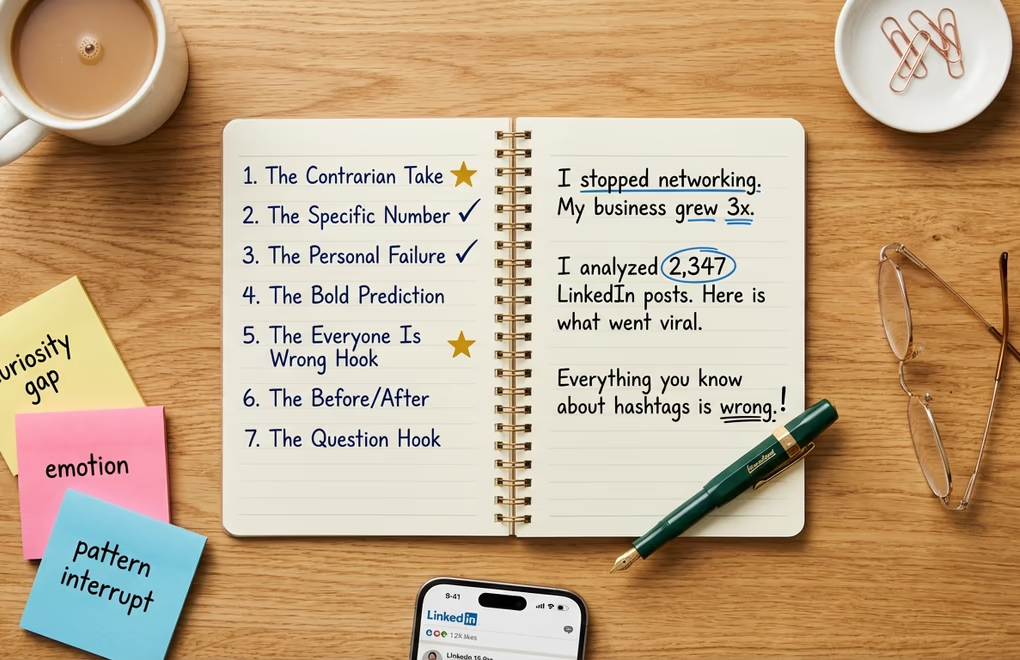
Now let us get practical. Here are 15 hook formulas that consistently drive high engagement on LinkedIn. Each one uses at least one of the psychological triggers we just covered. I have included real-world examples so you can see exactly how to adapt them to your own content. If you want to save time generating these, LinkedGrow's Hook Generator can create dozens of variations for any topic in seconds.
1. The Contrarian Take
Challenge something everyone assumes is true. This triggers both the curiosity gap and a pattern interrupt simultaneously.
"Networking events are a complete waste of time. Here is what I do instead."
2. The Specific Number
Odd, specific numbers feel more credible than round ones and immediately signal that you have real data to share.
"I analyzed 2,347 LinkedIn posts. The ones that went viral all had this in common."
3. The Personal Failure
Vulnerability drives massive engagement on LinkedIn. People connect with failure stories more than success stories because failure feels relatable and honest.
"I made $0 in my first 8 months as a freelancer. Here is what I learned the hard way."
4. The Bold Prediction
Making a specific prediction about your industry positions you as a thought leader and sparks debate in the comments.
"By 2027, 80% of LinkedIn content will be AI-assisted. But only 10% of it will actually perform well."
5. The "Everyone Is Wrong" Hook
Telling people that conventional wisdom is wrong immediately creates tension. They need to find out what the right answer is.
"Everything you have been told about LinkedIn hashtags is wrong."
6. The Before/After Transformation
Show a dramatic shift in results to create envy and curiosity about the method.
"6 months ago, my posts averaged 200 impressions. Last week, one hit 850,000. Here is the one change I made."
7. The Question Hook
A direct question forces the reader to mentally engage. If the question resonates with their experience, they cannot resist reading on.
"Why do your competitors get 10x the LinkedIn engagement with half the effort?"
8. The "I Should Not Share This" Hook
Making something feel exclusive or slightly taboo immediately increases its perceived value.
"My client asked me to delete this post. But I think you need to see it."
9. The Time-Stamped Lesson
Anchoring a lesson to a specific moment in time makes it feel like a story rather than advice, which is much more engaging.
"At 2 AM on a Tuesday, I realized my entire marketing strategy was built on a lie."
10. The Listicle Tease
People love lists because they promise a clear, structured payoff. But the hook needs to sell the value of the list, not just announce it.
"I spent $50,000 learning these 7 lessons about building a personal brand. Save yourself the money."
11. The One-Word Opener
Starting with a single impactful word, followed by a line break, creates a visual pattern interrupt that stands out in the feed.
"Burned out.
That is how I felt after 3 years of posting daily on LinkedIn."
12. The Social Proof Hook
Borrowing credibility from others or from your own results immediately tells the reader this is worth their time.
"This framework helped 3 of my clients go from 0 to 10K followers in 90 days."
13. The Myth Buster
Calling out a popular belief as a myth creates instant friction that demands resolution.
"Posting daily on LinkedIn does not help you grow. (And I can prove it.)"
14. The Confession
Admitting something uncomfortable positions you as radically honest, which is rare on a platform full of humble brags.
"I will be honest: I used to think LinkedIn was a waste of time. I was completely wrong."
15. The "Do Not Do This" Warning
Warnings trigger loss aversion, which is psychologically stronger than the promise of gain. People would rather avoid a mistake than gain an advantage.
"Stop doing this on LinkedIn. It is killing your reach and you do not even realize it."
You do not need to memorize all 15. Pick 3-4 that feel natural to your style and start rotating between them. Before you publish, run your opening line through a LinkedIn character counter to make sure it fits above the fold and looks right in the feed.
How do you test and optimize LinkedIn hooks?
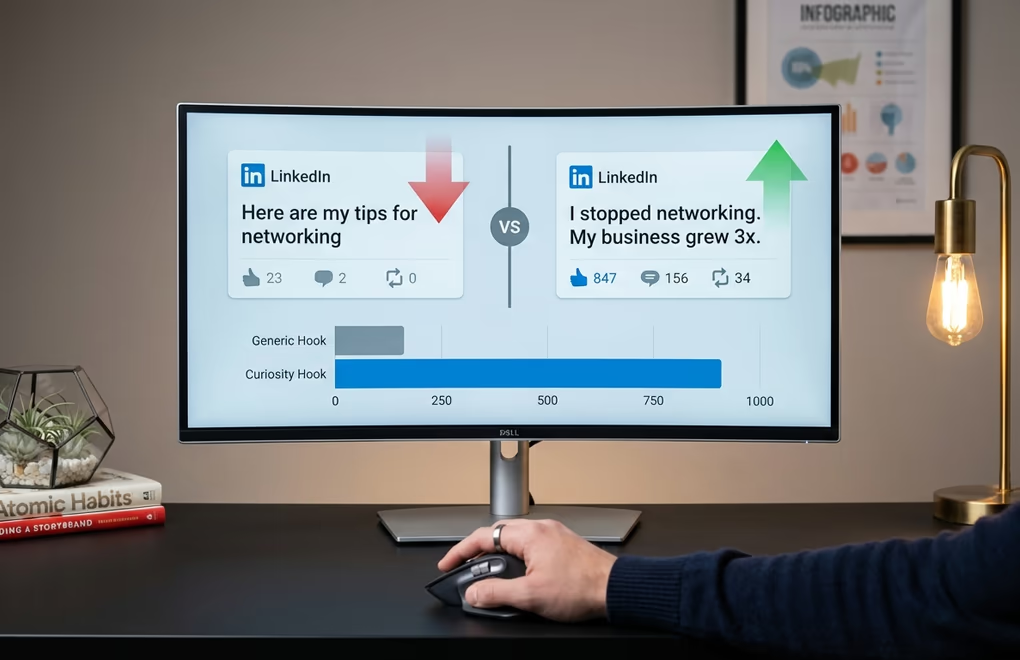
Knowing the formulas is only half the battle. The other half is figuring out which ones work best for your specific audience. What resonates with a tech startup crowd will not necessarily work for a real estate audience, and vice versa. Your profile headline also acts as a passive hook on every comment and connection request - run yours through the free LinkedIn headline analyzer to see how it scores on length, keywords, and value proposition. You need to test systematically.
The simplest way to test hooks is to keep a spreadsheet tracking three things for every post: the hook formula you used, the number of impressions, and the engagement rate. After 20-30 posts, patterns will start to emerge. You might discover that your audience responds incredibly well to contrarian takes but ignores confession-style hooks. That kind of insight is worth more than any generic best practices article could ever tell you.
A more advanced approach is true A/B testing, where you publish the same core content with two different hooks on different days and compare the results. The body of the post stays identical. Only the hook changes. This isolates the hook as the variable and gives you clean data. LinkedGrow's AI post generator can help you create multiple hook variations for the same content so you can run these tests efficiently.
Pay attention to the right metrics when evaluating hooks. Impressions tell you how many people saw the post, but the "see more" click-through rate is what actually measures hook effectiveness. Unfortunately, LinkedIn does not expose click-through rate directly. A good proxy is to compare the ratio of impressions to engagement (likes + comments). A post with 10,000 impressions and 50 comments means people are reading and interacting. A post with 10,000 impressions and 2 comments means your hook got the impression but people scrolled past. According to Hootsuite's LinkedIn data, image posts receive 2x higher comment rates than text-only posts - but even the best image cannot save a weak hook.
One more thing: do not judge a hook by a single post. LinkedIn performance varies based on time of day, day of week, what else is in the feed, and a dozen other factors you cannot control. A hook needs at least 3-5 uses before you can draw meaningful conclusions about whether it works for your audience.
What hook mistakes kill LinkedIn reach?
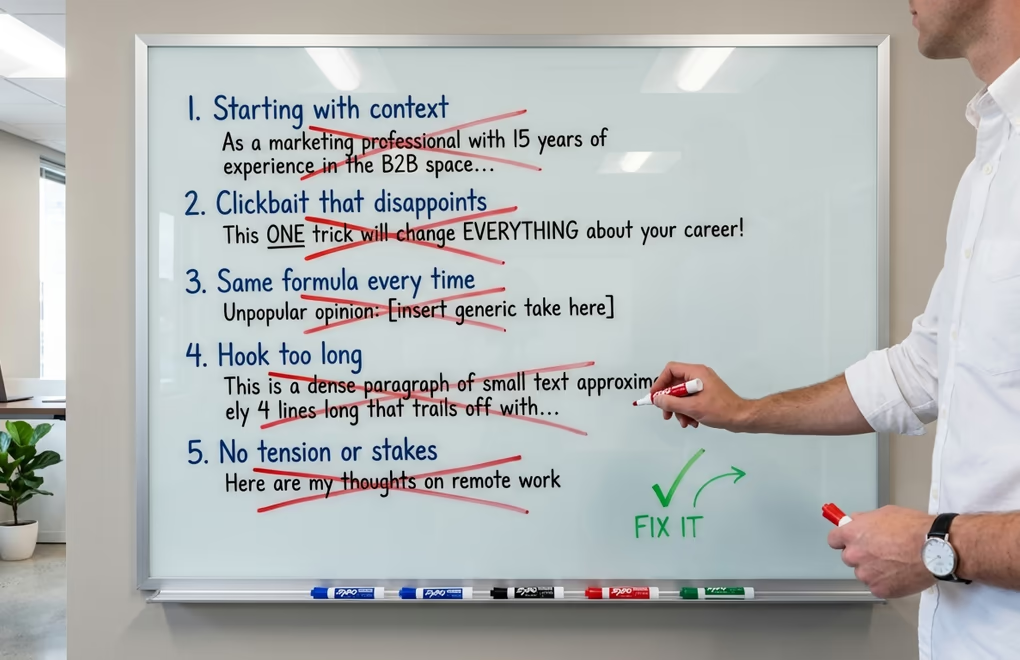
Knowing what works is important. But knowing what does not work might be even more valuable, because most people are making these mistakes every single day without realizing it. If you fix just these five things, your engagement will likely improve even before you start using hook formulas.
Starting With Context Instead of a Hook
This is the most common mistake by far. People open with background information: "As a marketing consultant with 15 years of experience, I have seen many changes in the industry." By the time you get to the interesting part, the reader is already gone. Always lead with the most interesting, surprising, or emotionally resonant part of your post. Context can come later.
Writing Clickbait That Does Not Deliver
There is a fine line between a compelling hook and a misleading one. If your hook promises something extraordinary, the post needs to deliver on that promise. "This one trick doubled my revenue" followed by generic advice about being consistent will destroy your credibility. People remember being let down, and they will stop clicking your posts entirely. Your hook should be the best possible version of the truth, not a lie.
Using the Same Hook Formula Every Time
Once people find a hook style that works, they tend to use it for every single post. The problem is that your followers start recognizing the pattern, and what was once fresh becomes predictable. If every post starts with "Unpopular opinion:" then it is no longer unpopular and no longer interesting. Rotate between at least 3-4 different formulas to keep your audience guessing.
Making the Hook Too Long
Remember, you have roughly 210 characters before the fold. If your hook is a full paragraph, the most important words might be hidden behind "see more." The best hooks are punchy and tight. One to two short sentences. Get in, create the tension, and let the reader do the rest. Every word in your hook needs to earn its place.
Forgetting to Create Tension
Informational hooks that simply state what the post is about fall flat every time. "Here are my thoughts on remote work" creates zero tension. Nobody needs to click "see more" to find out your thoughts because they are not invested yet. Compare it to: "I forced my entire team to come back to the office. Half of them quit. And I would do it again." Same topic. Completely different level of engagement because there is tension that demands resolution.
How do you turn every LinkedIn post into a scroll-stopper?
The gap between LinkedIn posts that go viral and posts that go nowhere almost always starts with the hook. Now you have 15 proven formulas, you understand the psychology behind why they work, and you know the mistakes to avoid. The only thing left is to start using them.
Here is what I would suggest: pick three formulas from the list that feel natural to your voice. Write your next three LinkedIn posts using them. Track the results. Then iterate. Within a few weeks, you will develop an instinct for what makes your specific audience click, and your engagement will follow.
If you want to accelerate the process, LinkedGrow's Hook Generator creates personalized, high-performing hooks tailored to your topic and writing style, and the match gets sharper once you train the AI to write in your voice. You can generate dozens of variations in seconds, test the best ones, and focus your energy on writing great content instead of staring at a blank first line. Try it free and see the difference a great hook makes.
Need help with your post structure beyond the hook? Browse our free LinkedIn post templates for proven formats that pair perfectly with these hook formulas, and use the LinkedIn text formatter to add bold and italic styling that makes your hooks stand out even more in the feed.
Frequently Asked Questions
A LinkedIn hook is the first 1-3 lines of your post visible before the 'see more' button. It determines whether someone stops scrolling to read the rest. Think of it as a headline - it is the gatekeeper for all the value in your post.
Aim for 8-15 words in the opening line. LinkedIn shows about 210 characters before the fold on desktop, less on mobile. Keep it punchy - one to two short sentences that create tension or curiosity.
Viral hooks create a curiosity gap, trigger an emotional response, or challenge a common belief. The best ones feel personal and specific rather than generic. They make readers need to click 'see more' to resolve the tension.
Start with 3-4 formulas and rotate between them. Using the same style every time becomes predictable - your audience starts skipping your posts. Test different formulas, track results, and expand once you know what resonates.
Yes. AI tools like LinkedGrow's Hook Generator create personalized hook variations based on your topic and writing voice in seconds. The key is always editing suggestions to match your authentic style - use AI as a starting point, not the final draft.
The post you keep meaning to write takes four minutes here.
LinkedGrow turns a link, a video or a rough idea into a LinkedIn post written in your own voice, then puts it in the calendar for the morning your audience is awake.
Start free for 7 days