
Last year, the median LinkedIn post lost almost half its impressions, and the drop was not gradual. It came from a single architectural decision inside LinkedIn's engineering team: the platform retired its old multi-pipeline ranking stack and replaced it with a 150-billion-parameter language model called 360Brew. If you have been wondering how does LinkedIn's 360Brew algorithm rank your posts in 2026, the short answer is that the rules have changed completely, and most creators are still optimizing for a system that no longer exists. At LinkedGrow, we have spent the last ninety days reading every disclosure, parsing the engineering paper, and benchmarking what works now against what no longer does on more than two thousand client posts.
The reason this matters is simple. LinkedIn now hosts more than 1.3 billion members, and the platform has to decide, for each of them, which posts deserve attention out of millions published every hour. The old system tried to answer that question with dozens of small specialized models stitched together. The new system answers it with one model that actually reads the content. That shift sounds technical, but the consequences are very practical: the hooks that pulled fifteen thousand impressions in 2024 now stall at three hundred, and the formats that felt safe last year are quietly being capped.
This guide walks through what 360Brew actually is, how it scores and distributes a post the moment you hit publish, what changed compared to the previous algorithm, which formats survive under the new model, how your profile gets classified into a topic cluster, and how to tell if your account is being suppressed. By the end, you will know exactly how to write, time, and structure posts that 360Brew rewards rather than ignores. Whether you publish for personal branding or run an agency feeding multiple client accounts, this is the playbook for the post-360Brew era.
What is LinkedIn's 360Brew algorithm?
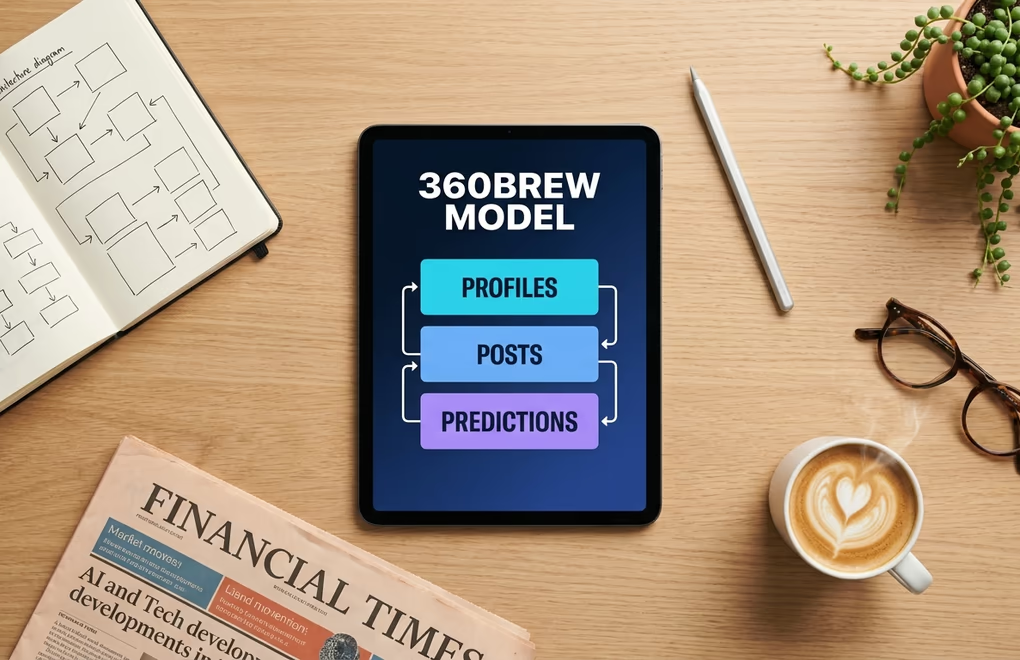
360Brew is a decoder-only foundation model that LinkedIn built on top of LLaMA 3 and fine-tuned on its own internal data. It is roughly the same family of architecture that powers ChatGPT and Claude, except it has been trained to predict which member of the network will engage with which post, comment, job, or connection. It is one model doing the work of more than thirty older specialized models, and it sits at the center of the feed, jobs, and people-you-may-know surfaces.
The old LinkedIn ranking system worked the way most social networks did until recently. It collected a long list of numerical features for each post, things like number of likes, number of comments, dwell time, click-through rate, sender-receiver affinity, and pushed those features through a chain of smaller models that scored the post for relevance. The pipeline was fast and cheap, but it had a hard ceiling. It could only see what the engineers thought to measure, and once you knew the features, you could game them.
360Brew breaks that pattern because it does not score features. It reads. The model takes a post, your profile, your history, and the candidate reader's profile, then asks itself a single question: would this specific person find this specific post valuable enough to stop scrolling and engage with it. Because the model understands language, it can recognize that a post about "Gong's revenue intelligence platform" and a post about "Salesforce CRM workflows" are talking about related ideas, even when neither uses the other's vocabulary.
LinkedIn's engineering team published the architectural shift in a March 2026 post on the LinkedIn Engineering Blog, and the practical takeaway is that the platform finally has a ranker that punishes thin content the same way a human reader would. If a post sounds generic, the model knows. If a hook is recycled from a viral template you copied last week, the model knows. That is why the median reach dropped, and why some accounts simultaneously saw their reach climb instead. The model rewards posts that say something specific, and it stops rewarding posts that just go through the motions of looking engaging.
How does 360Brew score and distribute your posts?
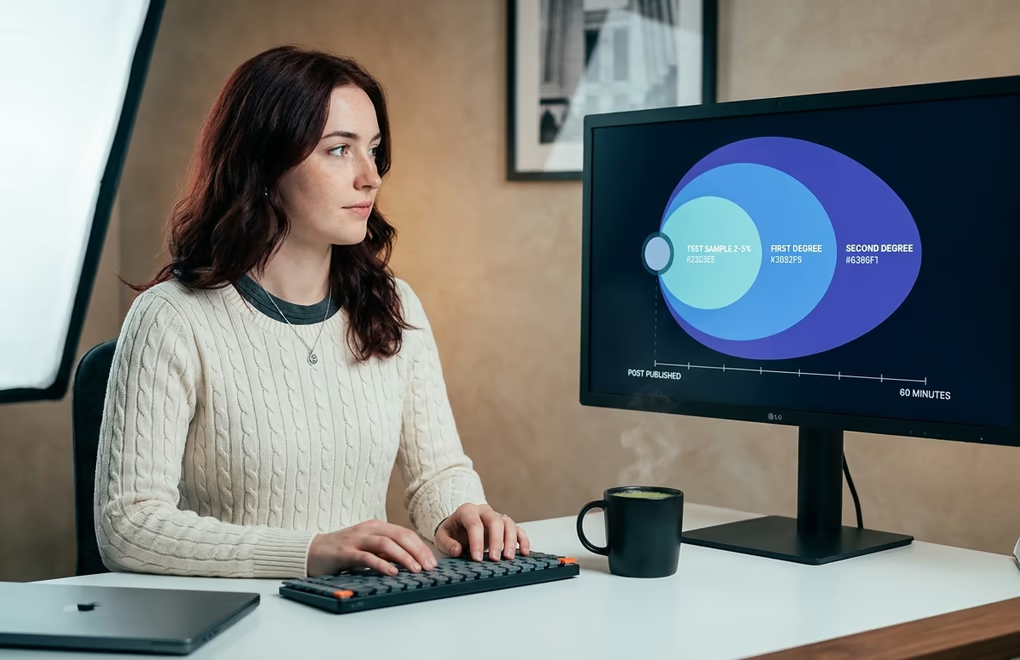
The moment you publish a post, 360Brew picks a small slice of your network as the initial test audience, usually somewhere between two and five percent of your first-degree connections plus a sprinkle of second-degree readers who match your topic cluster. This sample is not random. The model picks people whose profiles, history, and recent engagement patterns suggest they are the most likely to respond if the post is genuinely good. The first sixty to ninety minutes after you hit publish are the window where 360Brew watches what happens.
Inside that window, the model collects signals at a much finer grain than the old system did. It tracks how long each reader actually paused on your post, whether they expanded it past the "see more" line, whether they saved it, whether they wrote a comment longer than a few words, and whether the comments they wrote stayed on the same topic as your post. A single thoughtful comment from a reader whose profile matches your topic cluster is worth more than ten reactions from off-topic accounts, and saves now carry roughly four times the weight of a like.
If the early signals look strong, the model promotes the post to a wider audience in waves. First more first-degree connections, then second-degree readers in the same topic cluster, then third-degree readers who follow people who already engaged. If the early signals look weak, distribution caps out at that initial test slice and the post quietly stalls at a few hundred impressions no matter how long it stays online. There is no second chance window, and no late-night surge that rescues a slow start. The first hour is effectively the entire game.
The practical implication is that timing matters more than it used to, but in a different way. It is not just about hitting a peak hour, it is about being there to feed the early signals 360Brew needs. The free best time to post on LinkedIn tool gives you a personalized timezone heatmap based on 2M+ posts. Posting when your audience is actually online matters because the model needs warm bodies to react. Sitting on the post for the next sixty minutes and replying to every early comment with a real, fifteen-plus-word answer matters because comment threads with depth signal value to the ranker. Tools like post scheduling help you publish exactly when your audience peaks, which is half the work.
What changed when LinkedIn switched from the old algorithm to 360Brew?
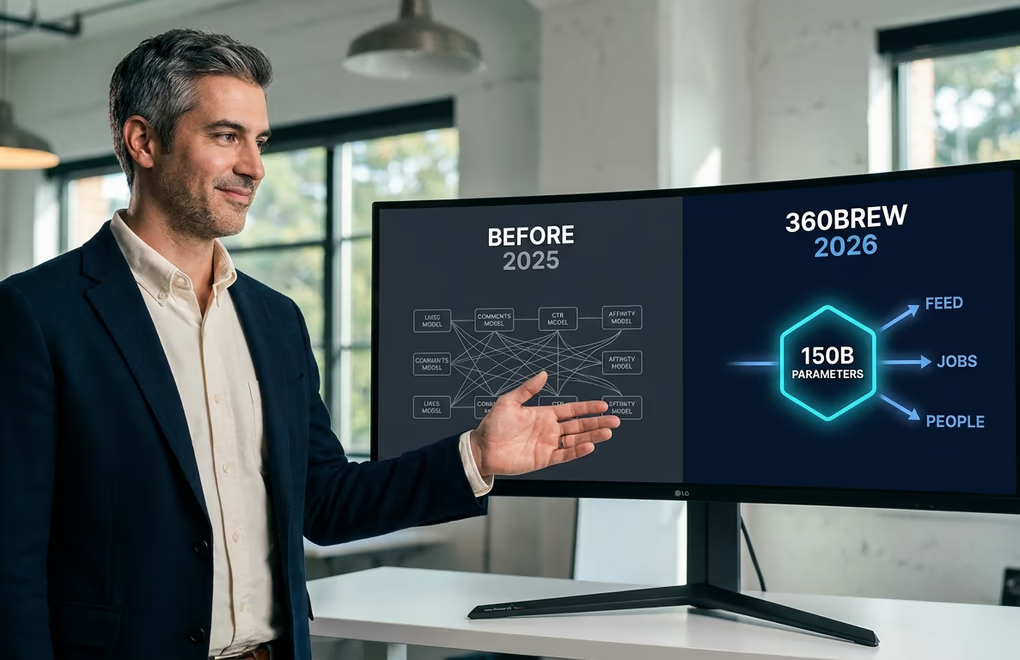
The first big shift is that engagement velocity now beats engagement volume. Under the old algorithm, a post that picked up two hundred comments over three days could keep getting served to new audiences for the entire window. Under 360Brew, a post that picks up forty comments in the first hour outperforms a post that picks up two hundred comments spread across three days, because the early signal is what unlocks the wider distribution. If your post does not generate movement in the first hour, it gets capped at the test sample and never recovers.
The second shift is that the value hierarchy of reactions changed. Saves are now the strongest positive signal because the model interprets them as a reader saying "this post is useful to me later, not just right now." Long comments come second, because writing more than a few words is a costly action that fakes badly. Reactions come third, and likes from accounts whose topic cluster does not match yours barely move the needle at all. The blanket-approach of begging for likes in the post itself stopped working in late 2025.
The third shift is that engagement pods finally got crushed. The old system could be tricked by a small ring of accounts always reacting to each other within minutes, because the system saw it as fast early engagement and scaled the post up. 360Brew sees the same coordinated activity as a topic-cluster mismatch, since the same accounts engage on every type of content regardless of topic. The model now flags this kind of pattern with high accuracy and applies a quiet reach penalty that can last sixty to ninety days. We have seen accounts go from eight thousand average impressions per post down to a few hundred overnight.
The fourth shift is the death of recycled hooks. The model has read so many LinkedIn posts that it can recognize a hook from a viral template the moment you publish it. Phrases like "I asked my CEO one question that changed my career" or "Here is the truth nobody tells you about" do not just bore readers anymore, they actively hurt your distribution because the model treats them as a quality flag. Original openers, even imperfect ones, now beat polished templated openers by a clear margin. The broader 2026 algorithm picture covers the rest of the smaller signal changes.
Which post formats does 360Brew actually reward?
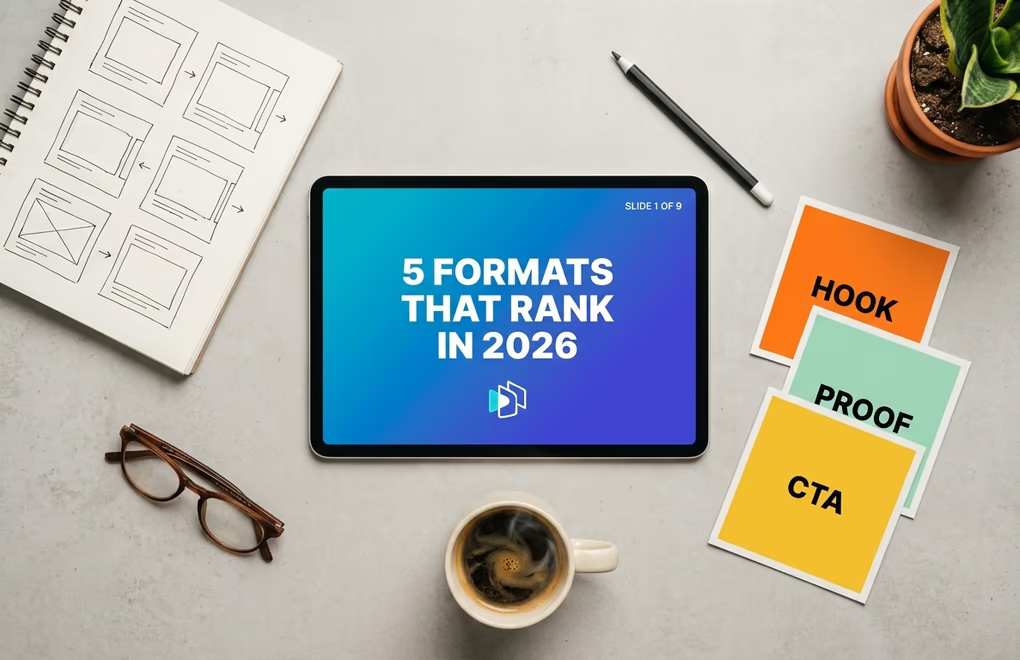
Document carousels, the PDF-based multi-slide format, are the clearest winner under 360Brew. They generate something the old algorithm never weighted properly: forced dwell time. A reader has to swipe through the slides, and that physical interaction tells the model the content is worth attention even before any reaction or comment shows up. Carousels are now reaching three to seven times the impressions of equivalent text posts, and they convert saves at a much higher rate than any other format because readers treat them as reference material. A weekly carousel is the single highest-leverage format change you can make.
Single-image posts come second. They beat text-only posts by roughly forty percent on average, partly because the image gives the eye somewhere to land in a fast-scrolling feed, and partly because they stop the scroll long enough for the "see more" click. The image does not need to be a designed asset, even a clean iPhone photo with on-topic context outperforms a stock illustration. Building a sustainable carousel rhythm is something most accounts can do once a week without burning out.
Native video collapsed under 360Brew, and the reason is structural. The model rewards completion rate, and most LinkedIn videos have a watch-through rate well below fifteen percent. The signal the ranker reads back is "people did not finish this," which it interprets as low value, which then caps distribution. Unless you are willing to invest in production quality good enough to hold attention past the first ten seconds, native video is no longer a reliable format. Short clips embedded inside carousels work better than full standalone videos for most creators.
Text-only posts still work, but only when the writing is genuinely strong. The model can tell when a post is structured to perform versus structured to inform, and it now favors the latter. Stories with a real specific detail in the first line outperform abstract claims by a wide margin, and posts with a clear point that someone could disagree with outperform safe consensus posts. The right format mix for most accounts in 2026 is one carousel, one image-led post, and one strong text-only post per week, with the carousel anchored on the day your audience peaks. A carousel generator built for LinkedIn solves the production bottleneck that stops most creators from posting them weekly.
How does 360Brew classify your topic DNA and cap your reach?
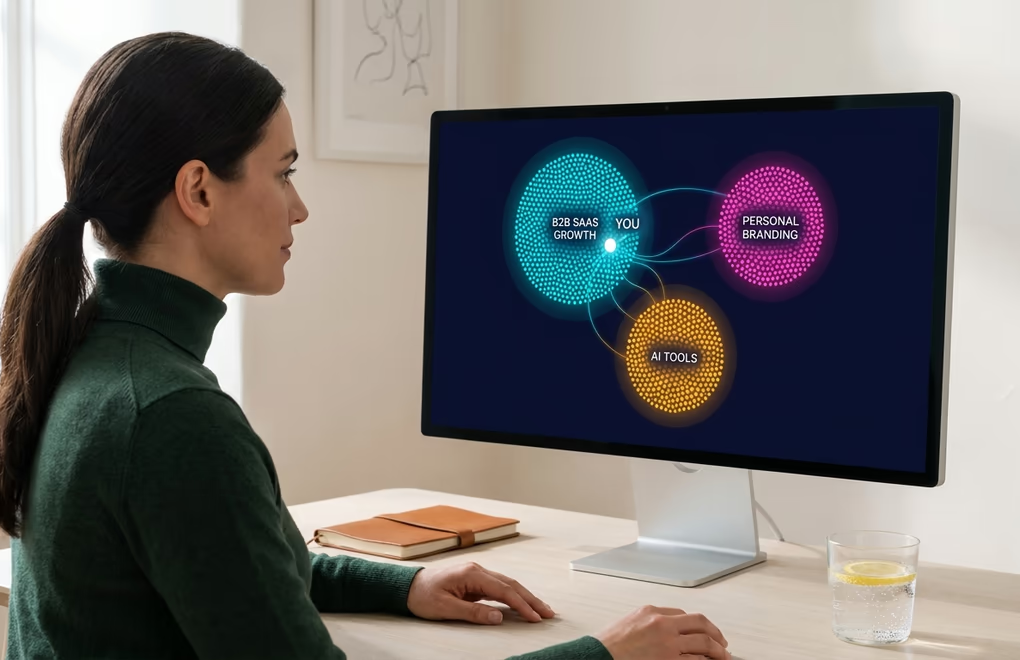
One of the biggest changes in 360Brew is that follower count is no longer the primary distribution lever. The model maps every active profile to one or two dominant topic clusters, then uses those clusters to decide who is a likely reader for each new post. A creator with twelve hundred followers in a tightly defined sub-niche can outperform a creator with fifty thousand followers across broad business topics, because the smaller account's topic cluster matches its audience cleanly while the larger account's cluster is too diffuse to point the model at the right people.
The classification process takes about sixty to ninety days of consistent posting before it stabilizes. During that window, the model is reading every post you publish, every comment you write on other people's posts, and the wording of your headline and About section, then updating its internal vector for who you are and who should see your content. Off-topic posts during this window dilute your topic vector and shrink your future reach, which is why so many creators see their accounts plateau exactly when they decide to broaden their content mix.
The fix is niche discipline. Pick one sub-niche narrow enough that you can describe it in five words, then keep every post on that pillar for at least ninety days. Your headline and About section need to use the same vocabulary your posts use, because the model treats those fields as strong signals about who you are. If your headline says "helping coaches scale to seven figures" but your posts mostly cover personal productivity tips, the topic vector pulls in two directions and your distribution suffers. Training a consistent voice across every post is half the battle, the other half is staying on-topic even when you have a cool but off-pillar idea.
The good news for new accounts is that 360Brew is faster to classify a tight niche than it was for the old algorithm to build affinity scores. Most creators who lock onto a clear sub-niche see distribution lift inside the first six weeks, even with a small follower base. The bad news for established accounts is that pivoting topics now triggers a reclassification window where reach drops while the model relearns who you are. If you are planning a content pivot, expect a four to six week reach dip and plan accordingly.
How do you check if 360Brew is suppressing your posts?
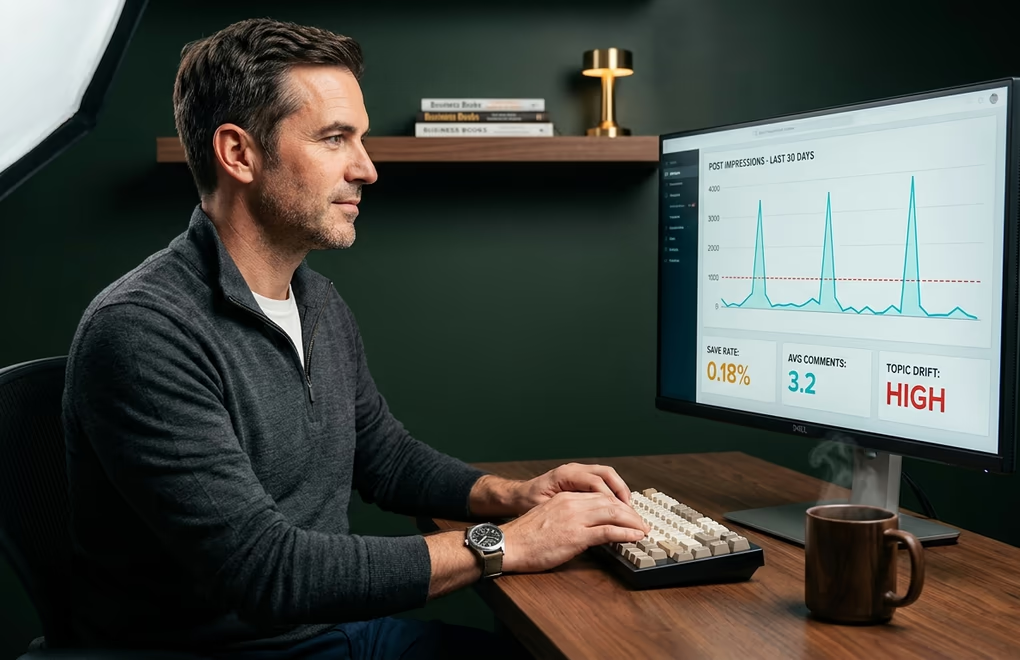
The first diagnostic to run is a thirty-day impression baseline. Pull the impressions for your last fifteen posts and look at the distribution. Healthy accounts under 360Brew show a clear top-and-bottom: a few posts breaking past two or three thousand impressions, and most posts landing somewhere between five hundred and fifteen hundred. If every single post in the last thirty days is stuck under three hundred impressions regardless of content, you are almost certainly inside a quiet reach penalty, and the cause is usually pod activity or topic dilution.
The second diagnostic is the first-hour signal check. For your last five posts, look at how many comments you had at the sixty-minute mark and how long those comments were. If most early comments are under five words or come from the same handful of accounts on every post, the model is reading them as low-quality signal and not promoting the post further. The fix is to stop relying on a fixed group of repliers and start writing posts that pull genuine reactions from new readers each time. A proper analytics view makes this kind of pattern obvious in a few clicks.
The third diagnostic is the topic coherence check. Read the last twenty posts on your profile and ask whether a stranger could describe your sub-niche in one sentence after reading them. If the answer is no, your topic vector is diffuse and 360Brew is hedging on your distribution. The fix takes ninety days of disciplined posting on a single pillar, but it is the single highest-leverage move for accounts whose impressions plateau without an obvious reason.
Beyond these three checks, the most reliable signal that 360Brew likes your content is the save-to-impression ratio. If saves are running at one percent of impressions or higher, the model is reading your posts as durably valuable and your reach will compound over the next several weeks. If saves are below 0.2 percent, the model is reading your posts as throwaway content and reach will keep tightening. Saves are the metric that matters most, and they are the metric most creators ignore. Track them weekly and let everything else be downstream of that one number.
Where this leaves you in 2026
The accounts that adapted to 360Brew in the first ninety days of rollout are now seeing three to five times the impressions they had in early 2025, while the accounts still optimizing for the 2024 playbook are stuck at a few hundred views per post and slowly losing followers. The shift is real, but it is also reversible for any account willing to retool. Pick a tight sub-niche, ship one carousel a week, post the rest in plain readable language, reply to every early comment for the first hour, and stop touching engagement pods. None of this is mysterious, and none of it requires you to chase the next algorithm hack. Build a posting rhythm you can sustain for ninety days, watch the saves number weekly, and let the model do the rest. The creators who win in 2026 are the ones who stopped trying to outsmart the ranker and started writing for real readers. Start with LinkedGrow if you want a system that handles the carousels, the scheduling, and the analytics on autopilot.
Frequently Asked Questions
360Brew is a 150-billion-parameter language model that LinkedIn now uses to rank every post in your feed. Instead of counting clicks and likes through a chain of smaller models, it reads each post and each profile semantically, the way a human reader would, and decides what to show next.
Most of the drop is because 360Brew rolled out across the feed and stopped rewarding the tactics that worked under the old system. Median reach for a typical post fell roughly 47% in the first year, and accounts that lean on engagement pods or recycled hooks took the hardest hit.
It does, but their weight changed. Saves and long, on-topic comments now signal real value far more strongly than reactions. Likes barely move the ranking unless they come from accounts that match the post's topic cluster and engage in the first sixty to ninety minutes after publishing.
It takes about sixty to ninety days of consistent posting in one topic cluster for 360Brew to settle on your profile's topic DNA. Until then, your reach is volatile because the model is still trying to figure out who should see your content and which audiences will actually find it useful.
Yes, and most accounts do recover within four to six weeks. Lock onto one sub-niche, post on a consistent rhythm, reply to early comments inside the first hour, and stop chasing engagement pods. 360Brew rewards real signals, so once your behavior cleans up, distribution returns.
The post you keep meaning to write takes four minutes here.
LinkedGrow turns a link, a video or a rough idea into a LinkedIn post written in your own voice, then puts it in the calendar for the morning your audience is awake.
Start free for 7 days