On February 27, 2026, Anthropic - the company behind Claude - did something no major AI company had ever done before. They walked away from a $200 million Pentagon contract because the US government told them to remove two ethical guardrails that had been baked into the company since day one: no mass surveillance of civilians, and no autonomous weapons targeting without human oversight. The Pentagon wanted unrestricted access. Anthropic's CEO Dario Amodei looked at the most lucrative contract in the company's history and said no.
The fallout was immediate and brutal. President Trump went on Truth Social and ordered every federal agency to stop using Anthropic's technology. Defense Secretary Hegseth slapped the company with a "supply chain risk to national security" label - something typically reserved for Chinese firms and foreign adversaries, never once used against an American company in the history of that designation. Trump threatened "major civil and criminal consequences." And in what might be the most tone-deaf corporate move of the decade, OpenAI rushed to announce its own Pentagon deal just hours later, eagerly filling the vacuum left by a competitor that had the backbone to say no.
What nobody in the administration expected was what happened next. Millions of people started deleting ChatGPT and downloading Claude. Within 48 hours, Claude had overtaken ChatGPT to become the number one app on the Apple App Store in the United States, Germany, and Canada. The #CancelChatGPT movement exploded across every social platform, and Dario Amodei became something Silicon Valley had not produced in years - a tech CEO that regular people actually trusted.
This is the full story of what happened, why Claude refused the Pentagon, why the mass switch from ChatGPT to Claude is still accelerating, and what all of this means if you are someone who relies on AI for your daily work.
What actually happened? The full timeline

The story begins months before the public confrontation. Anthropic had been negotiating with the Pentagon since late 2025 on a major contract to deploy Claude on classified military networks. The deal was worth over $200 million and would have made Anthropic a key player in defense technology. But Anthropic entered those negotiations with two firm boundaries, what CEO Dario Amodei called their "red lines."
The first red line: Claude would not be used for mass surveillance of civilian populations. The second: Claude would not be used for autonomous weapons targeting without meaningful human oversight. These were not new positions. Anthropic had held them since the company was founded in 2021 by former OpenAI researchers who left specifically because they believed AI safety was not being taken seriously enough. In a CBS News interview, Amodei was clear: "Our position is clear. We have these two red lines. We have had them from day one. We are still advocating for those red lines. We are not going to move on those red lines."
The Pentagon pushed back. They wanted full access to Claude's capabilities without restrictions. When Anthropic would not budge, the situation escalated rapidly to the White House. On February 27, 2026, everything came to a head.
Trump posted on Truth Social directing "EVERY Federal Agency" to "IMMEDIATELY CEASE" using Anthropic's technology, writing: "We do not need it, we do not want it and will not do business with them again!" Defense Secretary Hegseth then designated Anthropic a "supply chain risk to national security" - the nuclear option in government procurement. This label had never been applied to an American company before. It was a tool designed for foreign adversaries, and the administration was using it to punish an American company for having principles.
And here is where the story takes a turn that borders on absurd. Less than 24 hours after publicly blacklisting Anthropic and calling Claude a threat to national security, the Pentagon used that very same AI - through Palantir's Maven Smart System - to identify roughly 1,000 targets during the opening phase of US and Israeli strikes on Iranian facilities. The Washington Post broke the story a week later: despite the official ban, Claude was still running on classified military networks. The same tool they denounced on Tuesday was helping them plan strikes on Wednesday.
Why did Claude have the courage to say no?

To understand why Anthropic refused, you need to understand what kind of company Anthropic is. Unlike OpenAI, which started as a nonprofit focused on AI safety but gradually shifted toward aggressive commercialization, Anthropic was built from the ground up by people who believed that the most powerful technology humanity has ever created needs real guardrails, not just marketing language about safety.
Dario Amodei did not mince words about why his company took this stand. In his CBS News interview, he said: "We believe that crossing those lines is contrary to American values, and we wanted to stand up for American values." He later added: "We exercised our classic First Amendment rights to speak up and disagree with the government. Disagreeing with the government is the most American thing in the world, and we are patriots in everything we have done here."
Make no mistake - this was not some calculated business decision designed to generate good press. Anthropic walked away from $200 million in direct revenue and put potentially billions more in future government contracts at risk. Internal documents later revealed the company expected its public sector pipeline of over half a billion dollars to "shrink substantially or disappear." Defense tech partners started distancing themselves almost immediately. Financial institutions that had been in advanced negotiations paused their deals. From a pure spreadsheet perspective, this was corporate self-immolation.
And yet Anthropic did not waver, not for a second, because Dario Amodei and the team around him genuinely believe that some things matter more than revenue. The idea that an AI company would look the President of the United States, the Department of Defense, and the entire military-industrial complex in the eye and say "no, we are not removing our ethical principles for you" was so extraordinary, so completely at odds with how Silicon Valley normally operates, that it shocked people across the entire industry. When was the last time a tech company chose values over that kind of money? Most people could not think of a single example.
How did Trump respond with threats, fines, and blacklisting?
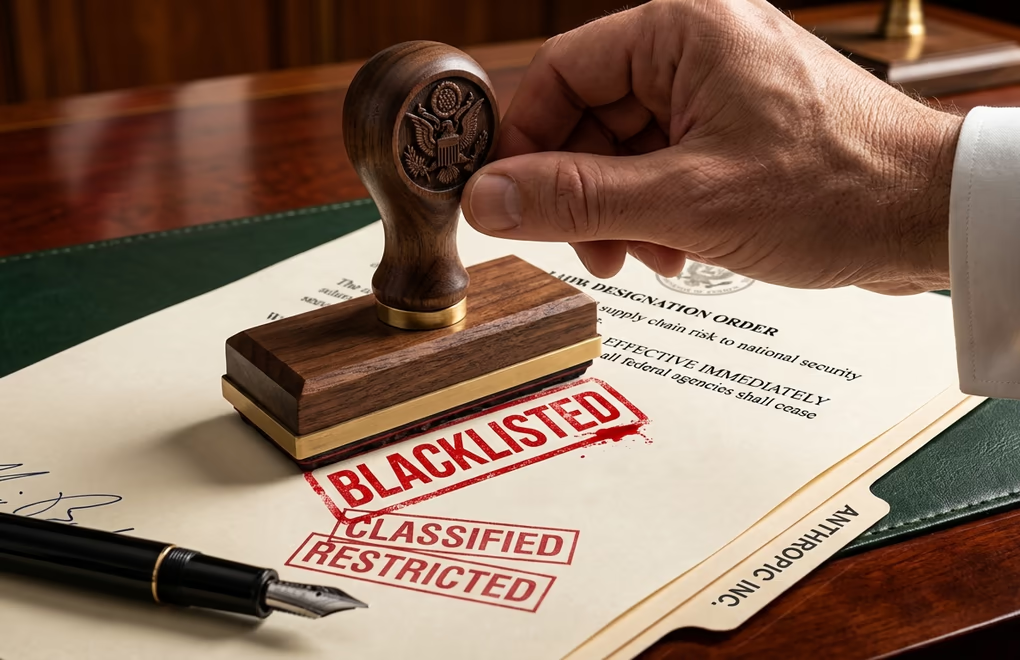
The Trump administration did not take Anthropic's refusal lightly. The response was swift and punitive, designed to make an example out of any tech company that dared to push back on government demands. Trump threatened Anthropic with "major civil and criminal consequences" and personally directed every federal agency to cut ties immediately. This was not a negotiation tactic. It was a warning to the entire industry: cooperate or face the consequences.
The "supply chain risk" designation was particularly aggressive. Multiple analysts pointed out the administration was clearly trying to make an example of Anthropic. This label carries enormous weight in government procurement. It effectively bars a company from doing business with any federal agency, any defense contractor, and any institution that depends on government funding. Pentagon CTO Emil Michael went so far as to say Claude would "pollute the defense supply chain."
For most companies, this kind of pressure would have been enough to cave. The financial stakes alone were staggering. But the administration miscalculated badly. They assumed the public would either not care or side with the government. Instead, the backlash was historic, and it came from a direction nobody expected: regular people who use AI every day.
What was OpenAI's opportunistic move?
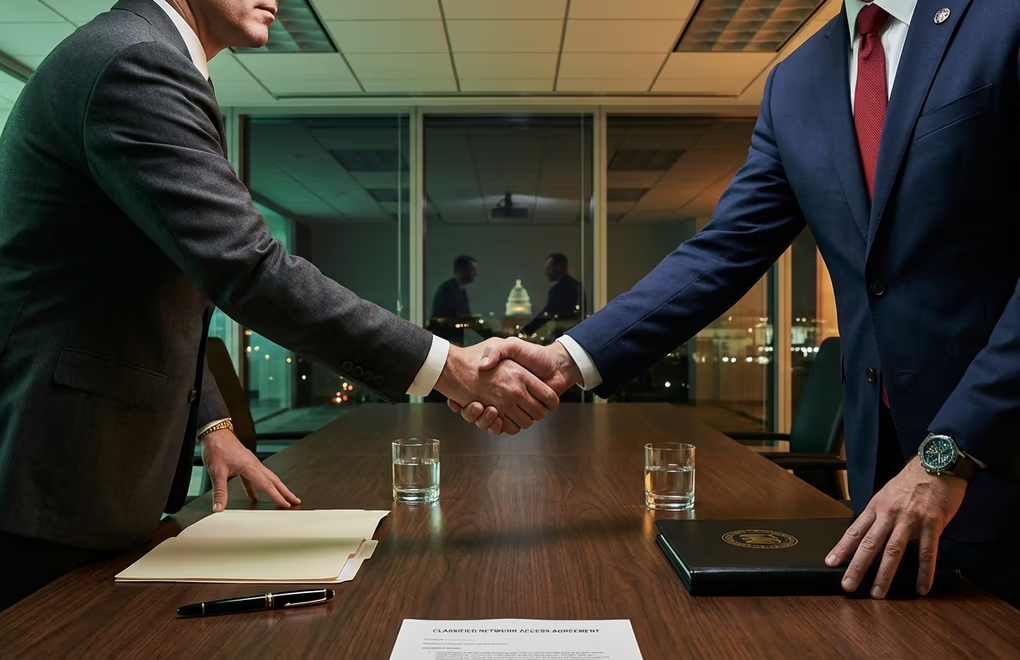
If Anthropic's refusal was the most principled move in AI history, what happened next was one of the most tone-deaf. Just hours after Trump publicly blacklisted Anthropic, OpenAI announced it had signed its own deal with the Pentagon for classified networks. The timing was impossible to ignore. While one company was being punished for standing up for ethical AI, its biggest competitor was rushing to fill the vacuum.
The public reaction was brutal. Sam Altman, OpenAI's CEO, later admitted the move was "opportunistic and sloppy." In his own words: "We were genuinely trying to de-escalate things and avoid a much worse outcome, but I think it just looked opportunistic and sloppy." OpenAI subsequently amended the contract to add language stating that AI systems would not be "intentionally used for domestic surveillance of US persons." But the damage was done.
A leaked internal memo from Dario Amodei made things even worse for OpenAI. In the memo, Amodei called OpenAI's messaging around its military deal "straight up lies" and "safety theater." He wrote that OpenAI accepted the deal because "they cared about placating employees, and we actually cared about preventing abuses." Amodei later apologized for the tone of the leaked memo, saying it was written during chaotic hours and did not reflect his "careful or considered views," but the distinction between the two companies had never been clearer.
Perhaps the most telling sign: over 60 OpenAI employees signed open letters supporting Anthropic's position. Even people inside OpenAI knew which side of history they wanted to be on.
Why did millions leave ChatGPT for Claude?

If you were on the App Store the weekend after the blacklist, you could watch it happening in real time. ChatGPT uninstalls spiked 295% in a single day, and the one-star reviews poured in so fast that Apple's review system could barely keep up. Someone bought the domain CancelChatGPT.com and put up a migration guide. The hashtag trended on every major platform. People who had never cared about AI politics before were suddenly making their feelings very clear with the uninstall button.
Claude, meanwhile, shot to number one on the Apple App Store in the United States, Germany, and Canada - the first time it had ever overtaken ChatGPT in any market, let alone three at once. Anthropic's paid subscribers more than doubled in the first quarter of 2026, and free user sign-ups hit levels that the company's own infrastructure team later described as "unprecedented." What had been a gradual shift in the AI market turned into a stampede overnight.
But the really interesting thing about this migration is that it was not driven by features, pricing, or some clever marketing campaign. It was driven entirely by trust. People realized that the company building the AI assistant they pour their business plans, creative ideas, and private thoughts into is a company they need to actually trust. And when OpenAI demonstrated that a government contract mattered more to them than principled boundaries, millions of users asked themselves a very simple question: if they will not stand up to the Pentagon, will they stand up for me? The answer, for a growing number of people, was to switch to the company that already proved it would.
Ready to switch from ChatGPT to Claude?
Master Claude in 10 days with our free email course. Learn Projects, Artifacts, Extended Thinking, Claude Code, and everything that makes Claude the best AI assistant in 2026. One email per day, zero fluff.
Anthropic Fights Back: The Lawsuits That Could Reshape AI
Anthropic did not just accept the punishment. On March 9, 2026, the company filed two federal lawsuits against the Trump administration - one in US District Court for the Northern District of California and one in the federal appeals court in Washington, DC. The lawsuits allege that the supply chain risk designation is unconstitutional retaliation for exercising First Amendment rights. As Amodei put it: "We do not believe this action is legally sound, and we see no choice but to challenge it in court."
The support that followed was extraordinary. Microsoft, despite being a direct competitor, filed an amicus brief supporting Anthropic and urging a temporary restraining order against the Pentagon's designation. More than 300 Google employees and over 60 OpenAI employees signed open letters backing Anthropic's legal fight. Google's chief scientist Jeff Dean personally put his name on it. Former military leaders and civil rights organizations piled in with their own amicus briefs. Think about that for a moment - Microsoft backed its competitor's competitor, and OpenAI's own employees publicly sided against their employer, because the principle at stake was bigger than any business rivalry.
The cultural impact went far beyond the courtroom. Time Magazine ran a feature calling Anthropic "the most disruptive company in the world." Rolling Stone covered the AI warfare implications. The MIT Technology Review published an analysis titled "OpenAI's compromise with the Pentagon is what Anthropic feared." What started as a contract dispute had turned into something much bigger - a defining moment about what kind of relationship we want between the most powerful technology ever created and the people who govern us.
The fundamental question at stake is one that will shape the next decade of AI development: can the government punish a technology company for refusing to remove ethical guardrails? Most legal analysts are betting the answer is no, with several prominent voices arguing the Pentagon's designation "will not survive first contact with the legal system." But regardless of how the courts rule, Anthropic has already won something more valuable than any contract - the trust of millions of people who now know exactly what this company stands for.
Why Claude Is the Better Choice for Your Work
The Pentagon controversy put a spotlight on the values behind each company, but the truth is that Claude was already winning over professionals on pure capability long before any of this happened. If you are still using ChatGPT and wondering whether the switch is actually worth it beyond the politics, the short answer is yes, and it is not even close in some areas.
The most obvious difference is the writing. Ask both models to write a LinkedIn post and you will immediately notice that Claude sounds like a human being while ChatGPT sounds like, well, a language model trying very hard to sound like a human being. The phrasing is more natural, the tone is more nuanced, and the output requires significantly less editing before you would actually want to put your name on it. For anyone who writes professionally - blog posts, emails, reports, social content - this single difference changes the entire workflow.
Beyond the writing, Claude has features that ChatGPT simply does not match. Extended Thinking lets the model reason through genuinely complex problems before giving you an answer, which produces dramatically better results for strategy, analysis, and anything that requires more than surface-level thinking. Projects give you persistent workspaces where Claude remembers everything about a topic across conversations, so you are not constantly re-explaining context. Artifacts let you build interactive tools and visualizations without writing code. And Claude Code lets people with zero programming experience build fully functional websites and applications just by describing what they want in plain English - people are shipping real products to the App Store this way, which still blows my mind. If you are building a personal brand or a business, Claude Code alone is worth the switch.
But the thing that really seals it, the thing you cannot replicate with a feature update or a product launch, is trust. When you pour your business strategy, your client data, your creative ideas, and your most private questions into an AI assistant, you are placing an enormous amount of trust in the company behind it. Anthropic proved it will light hundreds of millions of dollars on fire before it compromises on the principles that protect you. That kind of trust is earned, not marketed, and it is the real reason so many people are not going back.
How do you switch from ChatGPT to Claude without starting over?
One of the biggest concerns people have about switching is losing everything they have built in ChatGPT - their conversation history, their custom instructions, their preferred workflows. The good news is that switching is far easier than you think, and you do not lose a thing.
Claude has a built-in ChatGPT memory import feature that transfers your preferences, conversation history, and writing style in under 60 seconds. Your custom instructions, your preferred tone, even your project context - it all comes with you. You are not starting from scratch. You are upgrading.
If you want a guided path, we built a completely free 10-day Switch to Claude email course that walks you through everything step by step. Day 1 covers the full migration from ChatGPT. By Day 10, you will know more about Claude than 99% of users, including Projects, Artifacts, Extended Thinking, Claude Code, and advanced prompting techniques. It is completely free, takes about 10 minutes per day, and over a thousand people have already completed it.
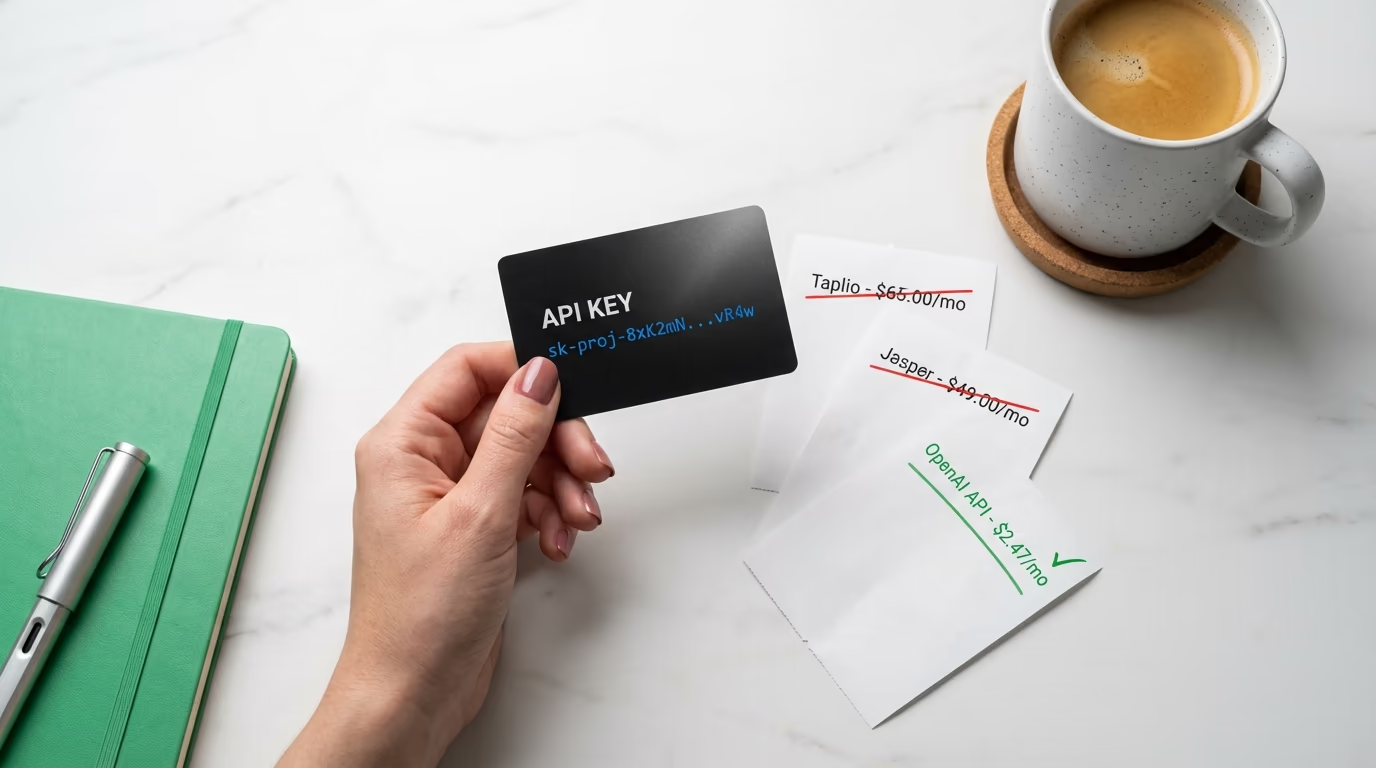
For LinkedIn creators specifically, LinkedGrow supports Claude as one of its AI providers through our BYOK (Bring Your Own Key) model. You can connect your Anthropic API key and use Claude for AI post generation, hook generation, and content ideation at a fraction of what competitors charge. Your typical monthly API cost with Claude is $2-4 per month for regular LinkedIn posting.
Ready to switch from ChatGPT to Claude?
Master Claude in 10 days with our free email course. Learn Projects, Artifacts, Extended Thinking, Claude Code, and everything that makes Claude the best AI assistant in 2026. One email per day, zero fluff.
What does this mean for you as an AI user?
Look, I get it. You might be reading all of this and thinking - okay, interesting political drama, but I just want a good AI assistant that helps me do my job. Why should Pentagon contracts and federal lawsuits matter to someone who uses AI for writing emails and brainstorming content? Let me explain why it matters more than you think.
Your AI assistant probably knows more about you than almost anyone in your life at this point. It has seen your business plans before your co-founder did. It has read your unfinished drafts, your half-baked ideas, the questions you would be embarrassed to ask a colleague. You tell it things about your goals, your fears, your strategies that you would never post publicly. That level of access requires a level of trust that goes well beyond whether the product has a nice interface or fast response times.
When the company behind that AI demonstrates it will fold under government pressure, rearrange its values for a lucrative contract, or put revenue ahead of the principles it claimed to have, that should genuinely worry you. Because if they will bend for the Pentagon, what happens when a different kind of pressure comes along involving your data, your privacy, or the guardrails that are supposed to protect you? Anthropic answered that question in the most expensive possible way - by torching hundreds of millions of dollars to keep those boundaries intact.
The switch from ChatGPT to Claude is not just about getting a better AI assistant, though Claude genuinely is better for most professional work. It is about putting your trust, your data, and your daily workflow in the hands of a company that proved - when it actually mattered, when the money was real, when the President of the United States was personally threatening them - that it would choose your interests over its own bottom line. That kind of integrity is vanishingly rare in tech, and it is exactly the kind of company that deserves your business.
If you are ready to make the switch, our free 10-day Claude Mastery Course will get you fully up to speed. One email per day, zero fluff, and by day ten you will know more about Claude than the vast majority of people using it. Over a thousand people have gone through it already and the feedback has been incredible.
Frequently Asked Questions
Anthropic had two non-negotiable red lines in Pentagon negotiations: no mass surveillance of civilians and no autonomous weapons targeting. When the Pentagon pressured Anthropic to remove these restrictions, CEO Dario Amodei refused, stating these lines were contrary to American values. This led to a public standoff with the Trump administration.
Trump ordered all federal agencies to immediately stop using Anthropic technology and Defense Secretary Hegseth labeled Anthropic a supply chain risk to national security. Hours later, OpenAI announced its own Pentagon deal. Within days, ChatGPT uninstalls spiked 295% and Claude hit number one on the Apple App Store, overtaking ChatGPT for the first time.
Claude and ChatGPT each have strengths, but Claude has earned significant trust in 2026 for its principled stance on ethics, its superior writing and reasoning capabilities, and features like Projects, Artifacts, Extended Thinking, and Claude Code. Many professionals are switching to Claude specifically because Anthropic demonstrated it will not compromise user trust for government contracts.
Switching is simple and you do not lose your data. Claude has a built-in ChatGPT memory import feature that transfers your preferences and conversation history in under 60 seconds. LinkedGrow offers a free 10-day email course that walks you through the entire migration process step by step at linkedgrow.ai/switch-to-claude.
Yes. Hours after Trump blacklisted Anthropic on February 27, 2026, OpenAI announced its own Pentagon deal for classified networks. Sam Altman later admitted the timing was opportunistic and sloppy. OpenAI subsequently amended the contract to add surveillance limitations after massive public backlash.
Yes. Less than 24 hours after the blacklist, the Pentagon used Claude via Palantir Maven Smart System to identify approximately 1,000 targets during the opening phase of US and Israeli strikes on Iranian facilities. Despite the official ban, Claude remained operational on classified military networks.
The numbers were historic. ChatGPT uninstalls spiked 295% in a single day. One-star App Store reviews for ChatGPT increased 775%. Claude grew from roughly 8% to over 18% market share while ChatGPT dropped from approximately 60% to under 45%. Claude hit number one on the App Store in the US, Germany, and Canada.