

Figuring out how to manage LinkedIn content for multiple clients as an agency is the challenge I hear about most from founders. They built their agency on Instagram management or Facebook ads, they are great at it, and then a client asks them to "also handle my LinkedIn." They say yes because it sounds like more revenue. Three months later, they are drowning. The posting cadence is inconsistent, the content sounds like it was written by the same person for every client, and engagement numbers are embarrassing. LinkedIn is not another social channel you can bolt onto your existing workflow. It demands a completely different approach, and agencies that understand this are building incredibly profitable practices around it.
The opportunity is enormous. The global social media management market is projected to grow from $32.48 billion in 2025 to reach $164.52 billion by 2034, growing at nearly 20% annually. Within that market, LinkedIn management is one of the fastest-growing niches because B2B companies are finally realizing that organic LinkedIn content generates more qualified leads than almost any other channel. But most agencies are still treating LinkedIn like they treat Instagram - batch some pretty graphics, slap on a caption, and schedule it. That approach fails spectacularly on a platform where audiences are sophisticated professionals who can spot generic corporate content from a mile away.
This guide is the playbook for agencies that want to manage LinkedIn content for multiple clients without sacrificing quality, burning out their team, or watching margins evaporate on bloated tool costs. You will learn the workflows that actually scale, how to maintain distinct voices across ten or twenty client accounts, and the pricing models that make LinkedIn management profitable at every tier. Whether you run a two-person shop or a 50-person agency, these principles apply because they are grounded in how LinkedIn's platform actually works and how real B2B audiences make decisions.
Why is LinkedIn management different from every other platform?

If your agency already manages content on Instagram, TikTok, or Facebook, you probably have a solid system in place. Visual assets, caption templates, hashtag research, scheduling tools - the core workflow is well established. But here is what catches most agencies off guard when they take on LinkedIn clients: none of those systems transfer directly. The audience is different, the algorithm rewards different behaviors, and the content that drives results looks nothing like what works on visual-first platforms.
On Instagram, a beautiful graphic with a two-line caption can generate thousands of engagements. On LinkedIn, that same approach falls flat because the audience is there to learn, not to scroll pretty images. LinkedIn rewards text-first content that demonstrates expertise and sparks professional conversations. The LinkedIn algorithm in 2026 specifically prioritizes what it calls "knowledge and advice" content, meaning posts that teach something, share a genuine perspective, or offer actionable insights get dramatically more distribution than generic brand messaging. For agencies, this means your content team needs to think like consultants, not graphic designers.
The other critical difference is that LinkedIn content is deeply personal. On Instagram, people follow brands. On LinkedIn, people follow people. Your client's LinkedIn presence is tied to their personal profile, their reputation, and their professional identity. When a post goes out under your client's name and it sounds nothing like them, their network notices. Their colleagues notice. Their prospects notice. The stakes are higher because every post is essentially your client standing in front of their professional peers and saying "this is what I think." Getting that wrong does not just waste a post - it can actively damage your client's credibility.
LinkedIn's own research backs up why this platform deserves specialized attention. According to LinkedIn's 2024-2025 B2B marketing insights, nearly three out of four decision-makers say thought leadership is a more trustworthy way to assess a company's capabilities than traditional marketing. Around 60% of buyers discover new brands through creator content, and employee networks are approximately 12 times larger than a company's own following - which is why a smart employee advocacy program often outperforms paid promotion of company-page posts for agency clients with a real team behind them. For agencies, these numbers tell a clear story: the content you produce for clients on LinkedIn is not just social media management. It is reputation management, thought leadership development, and lead generation rolled into one. Pricing and workflows should reflect that level of strategic value.
How do you maintain unique voices across every client account?
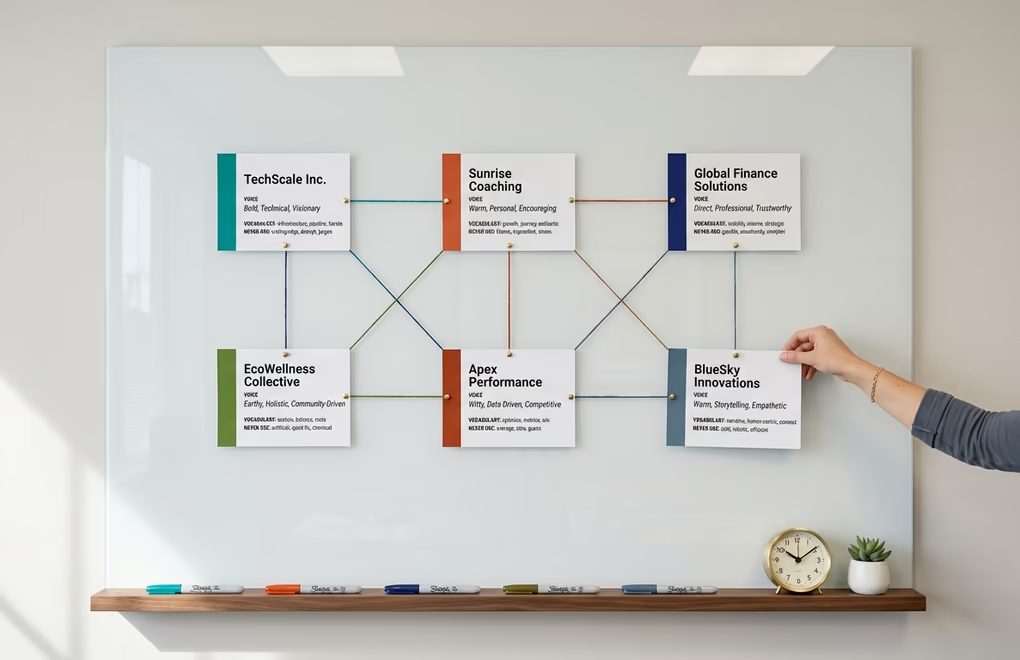
This is the single hardest challenge in LinkedIn agency management, and I have seen it sink agencies that were excellent at everything else. Most agencies in this space end up evaluating Taplio alternatives and AuthoredUp alternatives before settling on a stack - the right pick depends on whether you need per-client voice training (LinkedGrow) or per-client analytics (AuthoredUp). The free AI cost calculator also matters at agency scale because credit-based pricing breaks down fast across 10+ accounts. When you manage three or four LinkedIn accounts, keeping voices distinct is manageable. You know each client well, you have their quirks in your head, and switching between them feels natural. But the moment you scale to eight, twelve, or twenty accounts, something breaks. Posts start sounding the same. The SaaS founder sounds like the healthcare executive. The startup CEO sounds like the nonprofit director. And when that happens, you are not providing LinkedIn management anymore - you are providing generic content with different names attached.
The solution starts with rigorous onboarding. Before writing a single post for a new client, your team needs to build what I call a Voice Profile. This is a document that captures how the client actually communicates - not how they want to sound or how you think a CEO should sound, but their real voice. Ask the client for five to ten LinkedIn posts they are proud of. Listen to recordings of them speaking at conferences or on podcasts. Read their emails, their Slack messages, their existing content. You are looking for patterns: do they use short punchy sentences or long flowing ones? Do they swear occasionally or keep things buttoned-up? Do they use industry jargon or plain language? Do they tell personal stories or stick to business lessons? Every one of these details goes into the Voice Profile, and every writer on your team references it before drafting anything.
Technology has made this dramatically easier than it was even a year ago. Voice training tools can analyze a client's writing samples and learn their patterns - sentence structure, vocabulary preferences, tone, even the way they structure arguments. When your content team uses these tools to generate first drafts, the output already sounds 70 to 80% like the client. Your writers then add personal anecdotes, specific industry references, and timely observations that only a human who understands the client's world can provide. This hybrid approach, where AI handles the pattern matching and humans handle the personality, is how the best agencies scale without losing authenticity.
I also recommend a voice consistency audit every quarter. Have someone on your team who did not write the content read through the last month of posts for each client account. Can they tell the difference between Client A and Client B without looking at the names? If the posts feel interchangeable, your voice differentiation has slipped and needs recalibrating. The agencies that retain clients for years are the ones whose clients regularly hear from their own connections: "I love your LinkedIn content, it sounds exactly like you." When that happens, you have nailed it. The client gets complimented, they credit you internally, and they would never dream of switching agencies because they know how hard it is to find someone who truly captures their voice.
What agency content workflow actually scales?

After working with agencies of various sizes, I have found that the ones who thrive on LinkedIn all converge on a similar five-stage workflow. It does not matter whether they use Notion, Asana, or a shared spreadsheet - the stages remain the same. What matters is that every team member knows exactly where each piece of content sits in the pipeline and who is responsible for moving it to the next stage.
Stage one is ideation and planning. This happens on a weekly or biweekly cadence depending on how many clients you manage. Your strategist reviews each client's content pillars, checks what topics are trending in their industry, and maps out the posts for the upcoming period. This is also when you review the client's content calendar to ensure the mix of post types stays balanced across authority pieces, story posts, engagement prompts, and promotional content. The ideation stage should produce a simple brief for each post: the topic, the angle, the target emotion, and any specific details the writer should include.
Stage two is drafting. Your writer takes the brief, references the client's Voice Profile, and produces the first draft. This is where AI-assisted tools save the most time. Instead of staring at a blank page for each of fifteen client posts, the writer can generate voice-matched drafts and then spend their creative energy on editing, sharpening, and personalizing. A good writer using AI post generation with voice training can produce first drafts for three to four clients in the time it used to take to write for one. That efficiency gain is what makes LinkedIn management profitable at scale.
Stage three is internal review. A senior team member or strategist reads every draft before it reaches the client. They are checking for voice consistency, strategic alignment, factual accuracy, and the kind of polishing that elevates content from "fine" to "this is going to get engagement." The internal review is also where you catch the dangerous stuff: an opinion that might alienate the client's audience, a statistic that cannot be verified, or a story that might identify someone the client would rather keep anonymous. Never skip this stage, even when you are in a rush. One bad post under a client's name does more damage than five missed posting days.
Stage four is client approval. Send the batch of posts to the client with a clear deadline for feedback - 48 hours is standard. Include a note explaining the strategic thinking behind each post so the client understands why you chose that topic and that angle. Most clients will approve everything with minor tweaks. Occasionally a client will want significant changes, and that is fine - it is their name on the post. The key is setting expectations during onboarding that they get two rounds of revisions per post. Without that boundary, some clients will endlessly wordsmith and your team will never be able to move forward. Team collaboration tools that let clients review and approve directly in the platform eliminate the messy email chains that slow this stage down.
Stage five is scheduling and publishing. Once approved, posts go into the scheduling queue at each client's optimal posting times. For most B2B audiences, that means Tuesday through Thursday during morning business hours, though the best posting times vary by industry and time zone. Your team should also plan 15 to 20 minutes of post-publish engagement for each client - responding to comments, engaging with the client's network, and amplifying the post's early performance. This engagement window in the first hour after publishing is critical for LinkedIn's algorithm and something most agencies neglect entirely.
What do LinkedIn management tools actually cost at agency scale?

Here is the conversation nobody in the LinkedIn tool space wants to have honestly: tool costs at agency scale are brutal. When you are managing your own LinkedIn account, paying $49 or $65 per month for a tool feels reasonable. But when you multiply that by 10, 15, or 20 client accounts, those per-seat or per-account fees add up to a number that can completely destroy your margins. I have seen agencies spending $2,000 to $3,000 per month just on LinkedIn tools before paying a single team member. That is money coming directly out of your profit.
The problem gets worse when AI content generation enters the picture. Most tools that include AI lock you into their proprietary system and charge premium prices for it. You are paying for the tool subscription plus the AI usage, and you have zero control over which model generates your content or how much each generation costs. For an agency producing 40 to 60 posts per week across multiple clients, those AI costs can quietly add another $500 to $1,000 per month to your bill. When a client is only paying you $2,000 per month for LinkedIn management and you are spending $300 on tools for that one account, your effective hourly rate drops to something that would make you reconsider the entire service offering.
This is exactly why the BYOK (Bring Your Own Key) model is transforming agency economics. Instead of paying a tool vendor for bundled AI at marked-up prices, you connect your own API keys from providers like OpenAI, Anthropic, or Google and pay only for the tokens you actually use. The real-world cost difference is staggering. An agency generating 60 AI-assisted posts per week using their own API key might spend $8 to $15 per month in API costs. The same volume through a tool with bundled AI could cost $500 or more. That is not a marginal savings - it is the difference between a profitable LinkedIn management offering and one that barely breaks even.
There is another angle to the cost conversation that agencies should consider: client-owned AI keys. With a BYOK approach, you can have each client provide their own API key. The client pays $2 to $4 per month in AI costs directly, and your agency charges a management fee that is pure service value. This structure is transparent, the client sees exactly what AI costs, and your agency margins are protected regardless of how much content you produce. Compare that to bundled tools where you either absorb rising AI costs or pass them through with an uncomfortable markup. LinkedGrow's pricing model was designed with agencies in mind precisely because per-seat costs at scale need to be predictable and reasonable.
The same workflow question applies to the outreach half of a retainer, where one agency is working several client accounts at once. LinkedIn outreach automation covers that per client, with one daily budget per account rather than one per campaign, which is what stops two campaigns from quietly doubling the send.
How do agencies price their LinkedIn management services?

Pricing LinkedIn management is where most agencies either leave money on the table or price themselves out of the market entirely. The mistake I see most often is treating LinkedIn management like a commodity - charging per post or bundling it cheaply into a broader social media package. When you charge $50 per LinkedIn post, clients think of it as interchangeable content production. When you charge $3,000 per month for a LinkedIn thought leadership program, they think of it as strategic positioning. The framing matters enormously because it determines how clients perceive the value and how much latitude they give you to do the work properly.
The three-tier pricing model works best for most agencies. Your entry tier, typically $1,500 to $2,500 per month, includes two to three posts per week, basic engagement monitoring, and a monthly performance report. This tier attracts smaller businesses and solopreneurs who want consistent LinkedIn presence without doing it themselves. Your mid tier, typically $3,000 to $5,000 per month, adds more posting frequency, active engagement management where your team comments and interacts on behalf of the client, content strategy calls, and carousel or image content. This is where most B2B companies with real marketing budgets land. Your premium tier, $5,000 to $10,000 per month, includes everything in the mid tier plus personal branding strategy, executive ghostwriting, LinkedIn article creation, and detailed analytics with strategic recommendations.
One principle that transformed how I think about agency pricing: never charge for deliverables, charge for outcomes. Clients do not actually want three LinkedIn posts per week. They want more inbound leads, more speaking invitations, more partnership opportunities, more recognition in their industry. When you frame your pricing around those outcomes and demonstrate how consistent LinkedIn content creates them, the price conversation shifts completely. A $3,000 per month investment that generates two qualified leads per month for a consulting firm with a $50,000 average deal size is not expensive. It is the highest-ROI marketing spend in their budget. Position your pricing that way and you will never have to negotiate against cheaper alternatives.
Retainer models outperform project-based pricing for LinkedIn management because the platform rewards consistency above everything. A client who hires you for a three-month project, sees moderate results, and then stops posting loses everything they built. LinkedIn's algorithm favors accounts that post regularly over long periods, and the audience trust you develop compounds over time. When clients understand that LinkedIn content is like a savings account that grows with regular deposits, they commit to longer retainers. Offer a modest discount for annual commitments and watch your revenue predictability improve dramatically. Your churn drops because clients see the compound growth, and your team benefits from deep knowledge of each client that makes content creation faster and better over time.
Building a LinkedIn Practice That Clients Never Want to Leave
The agencies that dominate LinkedIn management share one thing in common: their clients stay for years, not months. That kind of retention does not come from fancy dashboards or slick reporting. It comes from consistently making the client look brilliant in front of their professional network. When a CEO gets a message from a prospect saying "I have been following your LinkedIn content and I would love to discuss how we can work together," that CEO credits the agency and never questions the retainer again. Every inbound lead that traces back to a LinkedIn post you wrote is another reason the client stays.
The playbook is clear. Invest deeply in voice training and brand differentiation for every client. Build a five-stage workflow that your team can execute without bottlenecks. Choose tools with transparent pricing models that protect your margins as you scale. Price your services around outcomes, not deliverables. And never forget that LinkedIn management is not social media management - it is professional reputation building, and the agencies that treat it with that level of strategic seriousness will own this market in the years ahead.
If you are building or scaling a LinkedIn management practice, the right tools make the difference between a service that is profitable and one that eats your margins alive. LinkedGrow was built specifically for this use case - voice training per client, team collaboration with approval workflows, visual content calendars across accounts, and BYOK AI pricing that stays reasonable whether you manage 5 clients or 50. The agencies that figure out efficient LinkedIn management now are positioning themselves for the most profitable niche in social media for the rest of this decade.
Frequently Asked Questions
Most agency managers comfortably handle 5 to 8 LinkedIn client accounts when using proper workflows and scheduling tools. Beyond that, quality suffers unless you have voice training systems and content calendars in place. Agencies managing 15 or more accounts typically assign 2 to 3 posts per client per week and dedicate one manager per 6 to 8 accounts.
Maintaining a unique, authentic voice for each client account. LinkedIn audiences are perceptive and will notice when posts sound generic or templated. Agencies that invest in voice training and detailed brand guides for each client produce significantly better engagement and retention than those using one-size-fits-all content approaches.
Most agencies charge between $1,500 and $5,000 per month per client for LinkedIn content management, depending on posting frequency, engagement management, and reporting depth. Retainer models work best because LinkedIn is a long-term strategy. Avoid per-post pricing since it incentivizes volume over quality and leads to client churn.
Yes, when the AI is trained on each client's unique voice. Generic AI tools produce cookie-cutter content that sounds the same across all accounts. Tools with voice training capabilities learn each client's tone, vocabulary, and style, so drafts already sound authentic. This cuts content creation time by 60 to 70 percent per client.
The most efficient agencies use a three-stage workflow: draft creation, internal review by a senior strategist, and client approval with a 48-hour window. Set clear expectations in your onboarding that clients get two rounds of revisions per post. Scheduling tools with team collaboration features eliminate the back-and-forth of email approvals entirely.
The people you just read about are already on LinkedIn.
LinkedGrow runs an agent that finds the ones who match the customers you already have, sends the invitation in your words, and opens the conversation. You pick it up when somebody answers.
Build my agent free